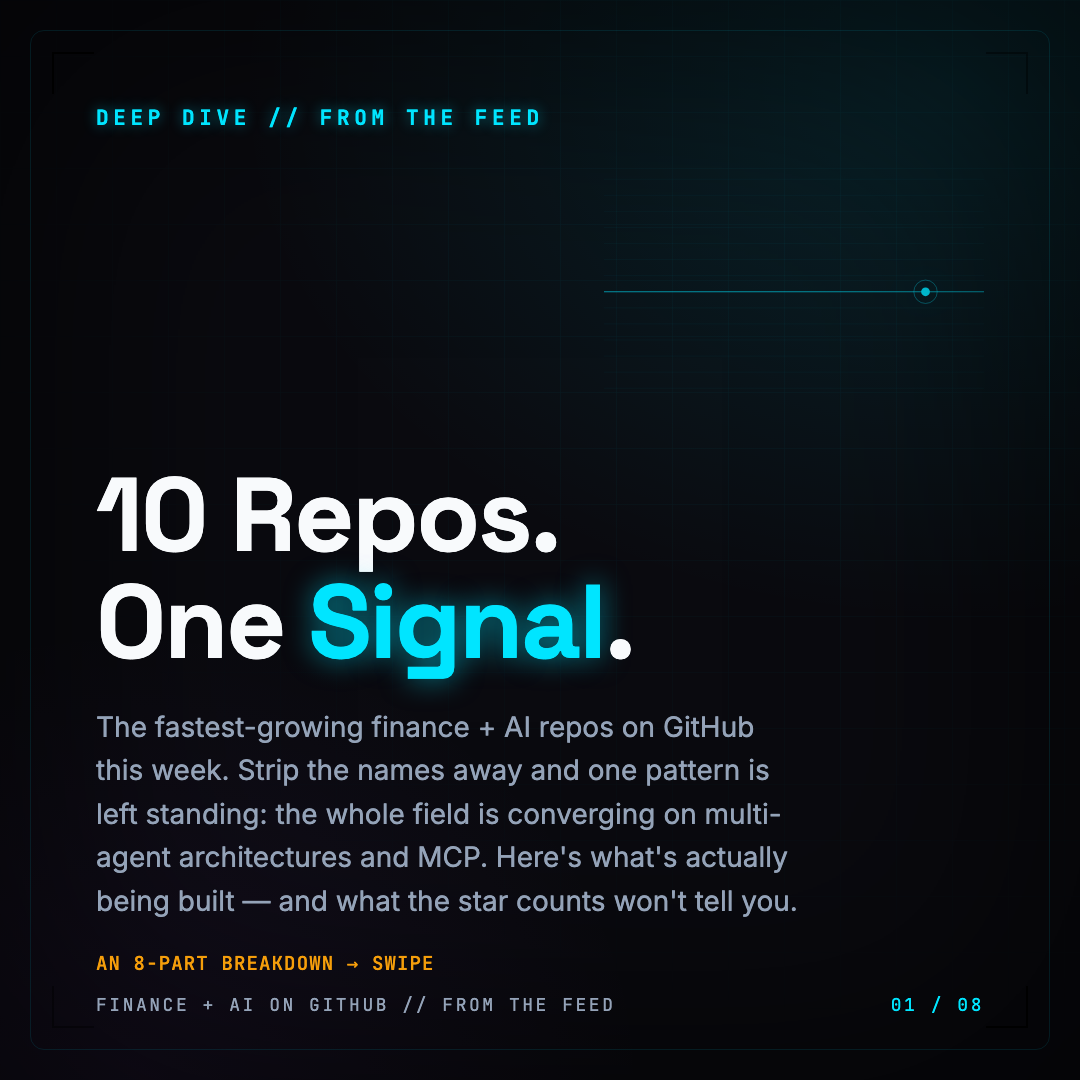
This week's fastest-growing finance + AI repos on GitHub. Strip the names away and one pattern is left standing: the whole field is converging on multi-agent architectures and MCP.
 ⊕ zoom
Ten repos topped the finance + AI charts this week. Strip the names and they're one architecture wearing ten logos — multi-agent core, MCP integration, data as the moat. The terminal wars are over interface; the real battle is whose agents read the cleanest data and whose orders actually fill.
Source: Fastest-growing finance + AI GitHub repos this week — @gusik4everWhy it matters
A weekly star-velocity leaderboard is a sentiment indicator for builders. It tells you where attention — and soon tooling and talent — is flowing. This week's finance + AI list is unusually coherent: strip the names and nearly every entry is the same architecture wearing a different logo. That convergence is the story, not any single repo.
I run multi-agent trading bots in production, so I read this list less like a ranking and more like a map of where the open-source crowd thinks the edge is. Short version: the field has standardized faster than most people realize.
The thesis. The terminal wars are over interface; the real battle is over data and execution. Multi-agent is now the default shape of a finance-AI app. MCP is becoming the default way agents reach their tools. What separates the winners is no longer the agent graph — it's whose agents read the cleanest data and whose orders actually fill.
The archetype: TradingAgents
TradingAgents (+~2,000 ★) is a multi-agent LLM framework that decomposes trading the way a real firm does: analyst agents gather and weigh signals, sentiment models read the tape, a portfolio-reasoning layer sizes and allocates, and an execution layer acts. It's the reference design for this entire list — once you've seen it, you'll recognize its skeleton in almost every other entry.
The data layer: OpenBB + sec-edgar-mcp
OpenBB (+~1,500 ★) is the open-source data spine for analysts, quants, and agents — equities, derivatives, crypto, fixed income, and macro behind one interface. sec-edgar-mcp (+~100 ★) is the plumbing for fundamentals: an MCP server that hands agents direct, structured access to SEC EDGAR filings, so an LLM can read 10-Ks and 10-Qs without a brittle scraper in the middle.
When every team can stand up the same agent graph in an afternoon, the differentiator stops being the model and becomes the inputs. OpenBB and sec-edgar-mcp climbing alongside the agent frameworks is the market pricing that in: clean, structured, agent-ready data is the part that's hard to replicate.
The integration story: MCP everywhere
Three separate entries — Vibe-Trading (+728 ★, HKUDS), sec-edgar-mcp, and TradingAgents-AShare — ship Model Context Protocol support as a headline feature. That's not a coincidence; it's a standard forming in real time. Stop hard-coding a bespoke API client per data source — expose capabilities as tools and let the agent decide when to reach for them. MCP is becoming the connective tissue of the finance-AI stack the way REST was for the last generation of fintech.
The outlier that says the most: MoneyPrinterTurbo
MoneyPrinterTurbo (+11,147 ★) is the loudest signal on the board — it took more stars in one week than every trading repo here combined. And it doesn't trade anything. It's a one-click AI short-video generator, "widely used in AI-driven content monetization pipelines."
Read the tea leaves. The single biggest spike in a "finance + AI" leaderboard is a tool for manufacturing content, not alpha. The crowd's revealed belief is that the reliable money in this space is selling attention and shovels — not beating the market. Worth sitting with before you spend a month tuning a trading agent.
The crowded field: five more terminals
The long tail is a dense, differentiated-on-paper field of AI trading terminals and research platforms:
- nofx (+~800 ★) — AI-native terminal for US stocks, commodities, forex, and crypto.
- QuantDinger (+726 ★) — live trading + backtesting; Binance, Alpaca, MT5, Coinbase.
- FinRobot (+~300 ★) — robo-advisory, report analysis, market research (AI4Finance).
- ValueCell (+~250 ★) — community-driven multi-agent investment research.
- TradingAgents-AShare (+~150 ★) — 15 agents simulating institutional debate on A-shares; Claude Code + Docker.
On the page they read as distinct products. In practice the differentiation is thin — most are the same multi-agent core pointed at a different asset universe. Differentiation is thin; execution isn't.
What the stars don't tell you
Here's what a star count cannot show you — and what actually determines whether any of these survives contact with a live market:
- A demo is easy; a fill is hard. A clean multi-agent graph is a weekend. A bot that survives a thin order book, a venue outage, or a stale quote is a different sport.
- Backtest-green is not live-green. Slippage, partial fills, fees, and latency eat the edge that looked obvious in a notebook.
- More agents, more silent failure. Every agent is another place the pipeline can fail without throwing. Add observability and a watchdog before the fifth agent, not after.
- The data layer breaks first. It's almost never the model that fails you in production — it's a malformed feed, a unit-semantics mismatch, or a rate limit. Instrument your inputs hardest.
This is the same discipline I write about across the Tesseract Intelligence thesis: the signal is cheap, the execution is everything.
What I'd research next
If I were allocating a research week against this list, here's the order:
- Benchmark TradingAgents on a real, recent regime — not the repo's demo window. Does the multi-agent debate actually beat a single well-prompted analyst, or is it ceremony?
- Stress the MCP data path. Wire OpenBB + sec-edgar-mcp into one agent and measure how it degrades when a feed is late, malformed, or rate-limited. That failure mode is where the money leaks.
- Price the MoneyPrinterTurbo thesis literally. If content monetization is where the crowd sees reliable return, what does an honest, repeatable content-to-revenue loop actually look like — and is it better risk-adjusted than trading at small size?
- Watch for consolidation. With this many near-identical terminals, expect a shakeout. The survivors will be the ones that own a data moat or a distribution channel, not a prettier agent graph.
Where to go deeper
The leaderboard refreshes every week. The pattern underneath it — multi-agent core, MCP integration, data as the moat, execution as the filter — is the part worth building around.
- Source: the original thread from @gusik4ever.
- More deep dives like this: jeremyknox.ai/deep-dives.
Explore the Tesseract Labs Ecosystem
Follow the Signal
If this was useful, follow along. Daily intelligence across AI, crypto, and strategy — before the mainstream catches on.
Claude Fable 5: We No Longer Verify the Work — We Verify the Direction
Thariq Shihipar from the Claude Code team lays out the 3 workflow changes Fable 5 made real — and the paradigm shift underneath all of them: we no longer verify the work, we verify the direction.

A Faceless Channel That Runs on Claude Code
The Zinny Studio published the exact Claude Code pipeline that runs her faceless channel — 11 skills, 9 agents, and a Notion kanban with a human gate at every column. The most honest automation breakdown on YouTube right now.
Blueprint: The “Should You Build It?” Machine
Building software is free now. Knowing what to build isn't. Blueprint runs a raw idea through a 5-stage framework and answers in numbers: build it, validate first, or rethink it entirely.