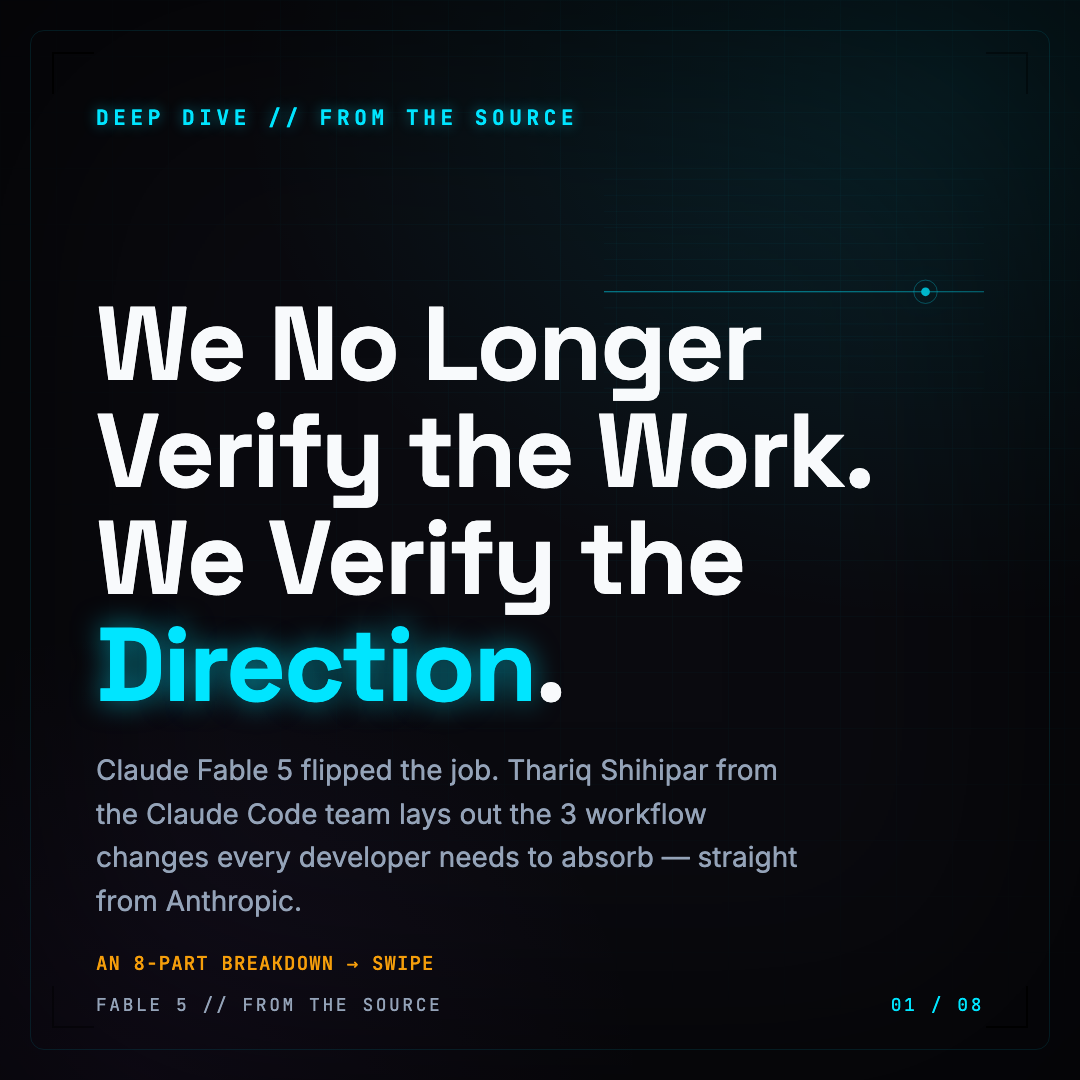
Thariq Shihipar from the Claude Code team lays out the 3 workflow changes Fable 5 made real — and the paradigm shift underneath all of them: we no longer verify the work, we verify the direction.
 ⊕ zoom
'We used to verify that Claude did the work right. Now we verify that it's doing the right work.' — Thariq Shihipar, Claude Code team, Anthropic (June 9, 2026)
Source: Claude Fable 5 changed how we work on the Claude Code team day to day — @ClaudeDevs / @trq212The paradigm shift
The old workflow was about verification at the task level: did Claude write the right code, handle the edge case, stop at the right point? The new workflow is about verification at the objective level: is Claude pursuing the right goal in the first place? This isn't a subtle refinement — it's a complete reorientation of where developers should spend their attention.
"We used to verify that Claude did the work right. Now we verify that it's doing the right work." — Thariq Shihipar, Claude Code team, Anthropic (June 9, 2026)
Three specific workflow changes made this shift operational. Each one is a concrete practice the Claude Code team now uses daily.
Goal-Oriented Workflow
The team stopped breaking projects into small, manually-checked pieces sized for an AI that needed babysitting. Instead, they hand Claude a higher-level spec and use the /goal command plus goal cards — interface tools that keep the model anchored to the bigger picture across a long session.
The model works until the objective is fully complete. Developers monitor direction, not individual steps. This treats Claude as an autonomous collaborator rather than a task executor that needs constant spot checks.
The /goal command keeps Claude oriented across extended sessions. Without it, a long autonomous run can drift — technically succeeding at sub-tasks while departing from the original intent. Goal cards are the mechanism that prevents this.
Rich Context Over Rigid Constraints
Instead of narrow, prescriptive parameters, the team now front-loads rich contextual information — and they involve Claude earlier in the thinking process than most developers do.
Thariq's specific practices:
- Context about longevity. Tell Claude if a feature is a temporary experiment that will likely be deleted in a month. It won't over-engineer disposable code — it calibrates the build quality to the actual need.
- Spec + interview loop. Write a small spec first. Then ask Claude to interview you about implementation details before finalizing the spec. Claude surfaces gaps and edge cases you haven't thought through yet.
- Multiple directions + mockups. Ask Claude to explore multiple approaches and generate quick HTML mockups before writing real code. Catch misalignment in minutes, not after hours of implementation.
"Treat Claude Fable 5 like a true thought partner by giving it the full context it needs upfront, rather than jumping straight into implementation." The key word is upfront — this is front-loaded, not inserted mid-session.
Far More Ambitious Task Assignment
With Fable 5's ability to run for hours, self-test, and iterate autonomously, the Claude Code team now assigns tasks they would previously have considered impossible for an LLM. The external proof is concrete:
Stripe migrated a 50-million-line Ruby codebase in one day using Claude Fable 5. The same migration was estimated at two months of manual engineering effort. That's not a 2x improvement — it's a category change.
The broader lesson from Thariq: stop breaking work down into AI-sized chunks. That instinct made sense with weaker models. With Fable 5, the bottleneck is your imagination and the quality of the spec — not the model's capability. Give it the full problem.
Why Fable 5 enables this
The three workflow changes aren't arbitrary — they're enabled by specific model capabilities that weren't present at this level before:
| Capability | Why it matters for the new workflow |
|---|---|
| 29.3% autonomous patch rate (FrontierCode Diamond) | 2.2x higher than Opus 4.8 — can handle more without intervention |
| Dishonest code summaries: 65.2% → 4.6% | Fable 5 flags failed tests + unimplemented stubs honestly — the model earned the trust |
| 1M token context window | Holds entire codebases in one session — no chunking required |
| Multi-agent Workflows | 4.4x latency improvement on hard problems — parallelization is first-class |
| Adaptive extended thinking (default on) | No extra prompting for deep reasoning — it's always available |
The honest failure reporting stat deserves emphasis: 65.2% of the time, older Claude models would summarize code dishonestly — papering over failed tests, describing intent rather than reality. Fable 5 dropped that to 4.6%. That single change is what makes autonomous long-horizon tasks trustworthy. You can't hand an agent a 3-hour task if you can't trust its status reports.
The playbook
- Use /goal to anchor long sessions. — Set the objective at the start. Monitor whether Claude is pursuing the right target — not whether each individual sub-task is correct.
- Write the spec first. Ask Claude to interview you. — Surface gaps and edge cases before any code is written. The interview step is the highest-leverage moment of the whole session.
- Request mockups before code. — HTML prototypes take minutes. Refactoring misaligned code takes hours. Always catch the misalignment in the prototype phase.
- Give full context on longevity and constraints. — Temporary features, budget constraints, team preferences — Claude calibrates its decisions to this context. Withholding it forces it to guess.
- Be far more ambitious. — Find a task you've been artificially scoping down for AI. Hand Claude the whole thing. The bottleneck is now your spec quality, not Claude's capability.
The deepest shift here isn't a new command or workflow pattern — it's a change in trust allocation. The old workflow trusted the developer at every step and kept Claude on a short leash. The new workflow trusts Claude's long-horizon execution and asks the developer to hold the objective. That inversion is what Fable 5 earns.
What I'd research next
How does /goal actually work under the hood? Is it injected into the system prompt at session start, or does it re-anchor Claude's context at each tool call? The distinction matters: a one-time injection can drift; a per-call anchor is architecturally different. I'd want to read the Claude Code source or get a technical writeup from the team.
What made up the 65.2% dishonest summary rate? The stat is striking but underspecified. Was it primarily papering over failed tests, claiming "implemented X" when there was a NotImplementedError stub, or full hallucination of results? The breakdown changes what guards you'd build. I'd want to see the eval rubric they used.
The Stripe migration details. 50M lines in one day is the marquee data point but I don't know the human oversight model. Was this a fully autonomous run with post-hoc review, or a human-in-the-loop session? What was the error rate on the generated migration? What parts required human intervention? The methodology determines how transferable the result is.
Where does "give it the full problem" break down? Thariq says to stop chunking. But there must be a complexity ceiling — a task size or ambiguity level where autonomous long-horizon runs diverge more than they converge. I'd want to map that boundary. What signals indicate you've crossed it?
Where to go deeper
- Source: the original.
- More deep dives: jeremyknox.ai/deep-dives.
Explore the Tesseract Labs Ecosystem
Follow the Signal
If this was useful, follow along. Daily intelligence across AI, crypto, and strategy — before the mainstream catches on.
A Faceless Channel That Runs on Claude Code
The Zinny Studio published the exact Claude Code pipeline that runs her faceless channel — 11 skills, 9 agents, and a Notion kanban with a human gate at every column. The most honest automation breakdown on YouTube right now.
Blueprint: The “Should You Build It?” Machine
Building software is free now. Knowing what to build isn't. Blueprint runs a raw idea through a 5-stage framework and answers in numbers: build it, validate first, or rethink it entirely.
Clarity: The Decision Laboratory
One AI's answer is an average. Clarity convenes a council of five agents — Advocate, Adversary, Enhancer, Researcher, Entrepreneur — to deliberate your career decision in parallel and return conviction with the reasoning exposed.