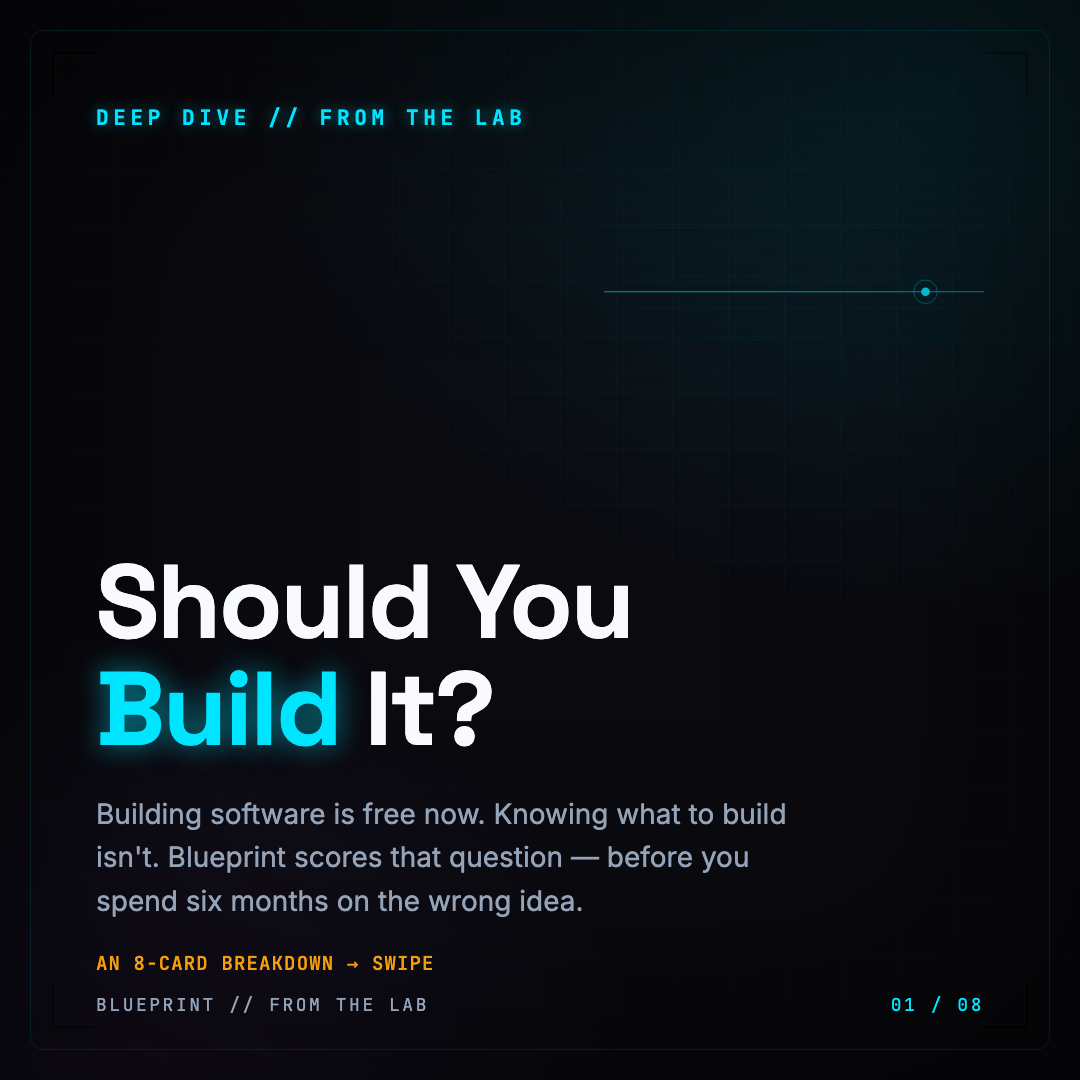
Building software is free now. Knowing what to build isn't. Blueprint runs a raw idea through a 5-stage framework and answers in numbers: build it, validate first, or rethink it entirely.
 ⊕ zoom
Full disclosure: I built this — so judge Blueprint by the only test that matters: would I run my own next idea through it before writing a line of code? I already do. Building is free in 2026; picking wrong still costs you six months. A machine that tells you NOT to build is worth more than another tool that helps you build faster.
Source: Blueprint — From Idea to Execution — Jeremy KnoxWhy this matters
Vibe coding lowered the build barrier to zero. Anyone can ship software with AI in 2026 — which means the barrier moved. It's no longer “can I build it.” It's “should I build it” and “will anyone pay for it.”
That shift created a new failure mode at scale: builders starting with the technology instead of the problem. Every week brings another wave of “go build a chatbot, sell an automation, start an AI business” content — and most of those businesses die because nobody pressure-tested the idea before the build started.
Blueprint is the corrective. It forces problem-first thinking before the build — the tool operators use before they build the thing they'll sell.
The most expensive mistake in 2026 isn't building badly — it's building the wrong thing well. Blueprint exists to catch that mistake while it's still cheap.
The Builder's Framework — five stages
Every interaction anchors to a cascading 5-stage system that takes an idea from ambiguous concept to executable roadmap. The stages are sequential but not rigid — new information sends you back, on purpose.
- Clarify — define the real problem, the real audience, and what success actually looks like. Most people skip this stage and solve a problem that doesn't exist. Output: problem statement + value prop.
- Architect — design the solution structure: core components, MVP scope, user journey, dependency map. Architecture is the system of decisions, not code design. Output: component map + MVP scope.
- Validate — surface the assumptions most likely to kill the idea and test them cheaply before building. Every assumption gets a stable ID that adversarial reviews reference later. Output: ranked assumption map.
- Execute — turn the validated plan into a sequenced build with gates and decision criteria. Output: roadmap with gates.
- Scale — what to systematize, when — and what to deliberately not do yet. Output: scale plan.
The ERS scorecard — seven dimensions, one number
The Execution Readiness Score is Blueprint's automated feedback engine. Seven dimensions, each scored 0–10, summed and scaled to 0–100. Three verdict bands: GO_BUILD, VALIDATE_FIRST, RETHINK.
Score the submission, not the category. “Ride-sharing is huge” and “AI is scalable” earn nothing. Every dimension score must reflect the specific mechanism described in this plan. Missing information scores low — with an explanation of exactly what evidence would change the score.
Quick Score — rigor with a pulse
A scorecard you don't remember is a scorecard you don't act on. Quick Score extends the ERS with fields engineered to be felt:
- Survival odds — a blunt 0–100% derived from the score and risk profile.
- Killer risk — one sentence: the single most likely cause of failure, grounded in your lowest-scoring dimensions.
- Pivot suggestion — when the score is low, one alternative framing worth considering.
- Three blocking questions — “must answer before building.” Each targets your weakest dimensions and requires real evidence, not vibes.
- A snarky closer — a one-liner about your riskiest dimension. Memorable beats comfortable.
The full pipeline
Quick Score is the front door. The pipeline behind it goes from raw idea to a prompt you can hand a coding agent:
| Mode | What it produces |
|---|---|
| Quick Score | Instant ERS verdict + survival odds + blocking questions |
| Stage Guide | 5-stage development roadmap with gates |
| Blueprint Generator | Full build spec: architecture, assumptions, next actions |
| Pressure Test | Adversarial premortem — what kills this idea |
| Debrief | Synthesis: one ranked priority action list |
| Claude Code Handoff | A structured build prompt for your coding agent |
Around the pipeline sits the working surface: an idea lifecycle Kanban board, ERS history over time, shareable scorecards, team voting sessions, and a public leaderboard.
Who it's for
- The vibe coder — can build anything in a weekend, has three ideas right now, scared of picking wrong. Needs rapid signal on which idea has legs.
- The aspiring AI agency founder — deciding which AI system to build and sell. Needs adversarial validation of the niche before committing.
- The operator-turned-builder — deep domain expertise, sees the AI opportunity in their industry, not a developer. Needs structured thinking that surfaces blind spots.
How it's built
React 18 + Vite frontend, Vercel serverless API, Neon Postgres with Drizzle ORM, Claude doing the reasoning, Stripe for billing. Shipped behind ~660 tests after a deliberate pre-launch hardening pass.
Free tier scores your idea in one pass and includes a taste of the Pressure Test. Founder ($49/mo) unlocks the full pipeline; Pro ($99/mo) adds unlimited runs and Strategic Review; Agency (from $499/mo) adds API access and seats.
What I'd research next
- Calibration against reality. Does GO_BUILD actually correlate with ideas that survive 12 months? The honest version of this product publishes its hit rate.
- Score stability across model versions. When the underlying model upgrades, does the same idea score the same? Drift needs measuring, not assuming.
- AI vs. human judgment. Run the same idea past the scorecard and a panel of operators — where do they disagree, and who's right more often?
- Leaderboard dynamics. A public leaderboard of scored ideas is a discovery mechanism — does it stay signal as it grows, or drift to noise?
Where to go deeper
Run your own idea at askblueprint.jeremyknox.ai — the free tier scores it in one pass. The thinking behind the framework lives on the blog, and more dives like this at jeremyknox.ai/deep-dives.
Money quote. “The barrier is no longer ‘can I build it’ — it's ‘should I build it’ and ‘will anyone pay for it.’”
Explore the Tesseract Labs Ecosystem
Follow the Signal
If this was useful, follow along. Daily intelligence across AI, crypto, and strategy — before the mainstream catches on.
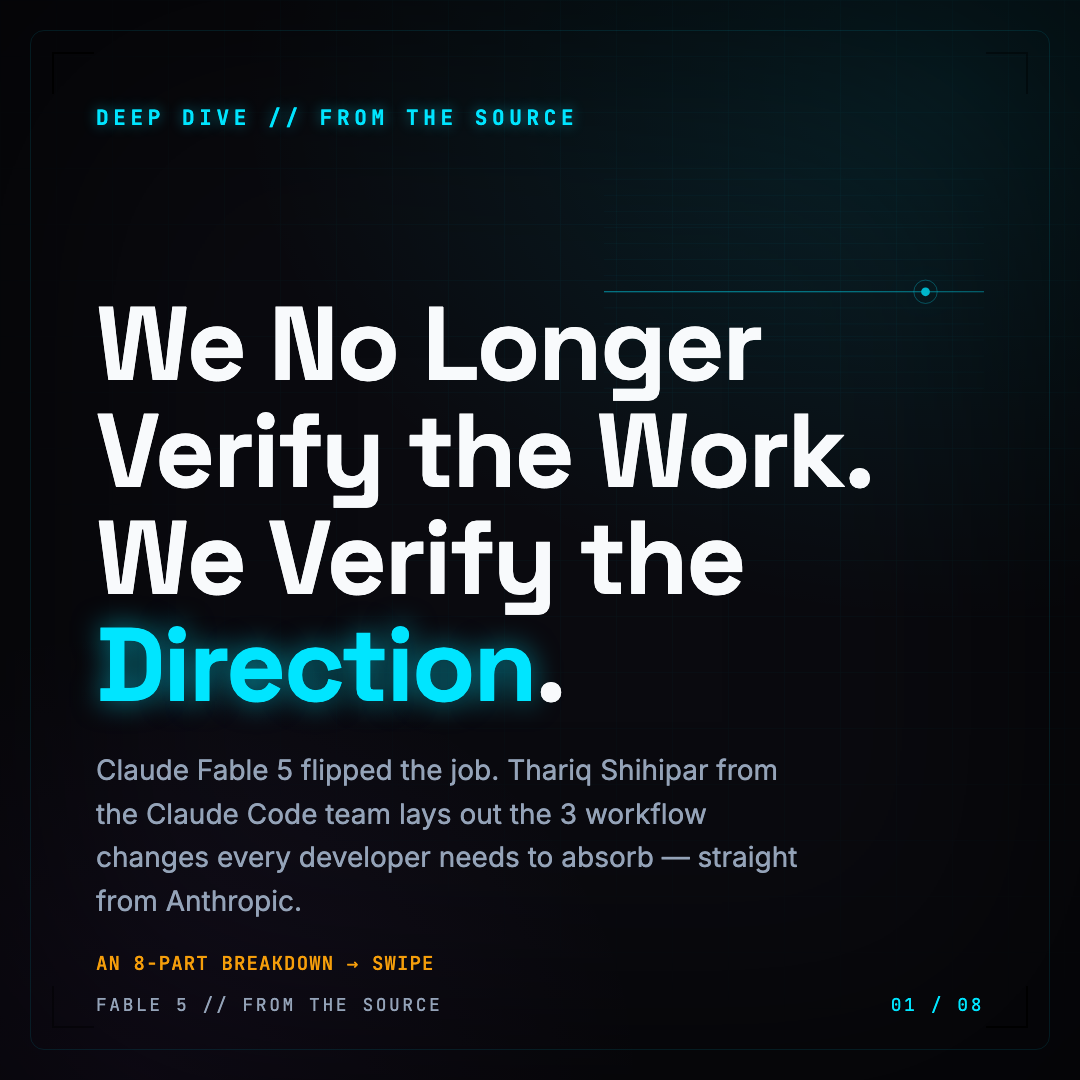
Claude Fable 5: We No Longer Verify the Work — We Verify the Direction
Thariq Shihipar from the Claude Code team lays out the 3 workflow changes Fable 5 made real — and the paradigm shift underneath all of them: we no longer verify the work, we verify the direction.
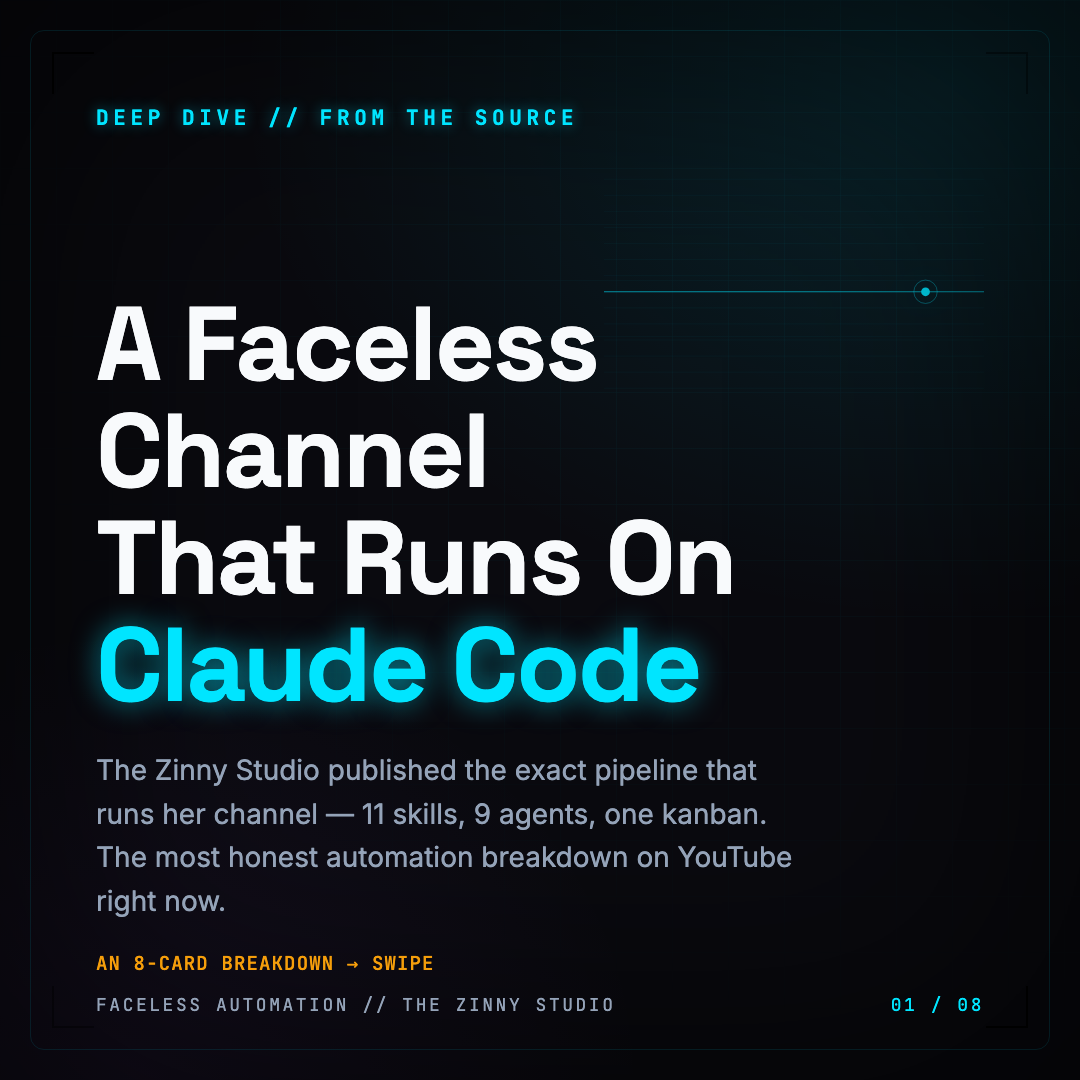
A Faceless Channel That Runs on Claude Code
The Zinny Studio published the exact Claude Code pipeline that runs her faceless channel — 11 skills, 9 agents, and a Notion kanban with a human gate at every column. The most honest automation breakdown on YouTube right now.
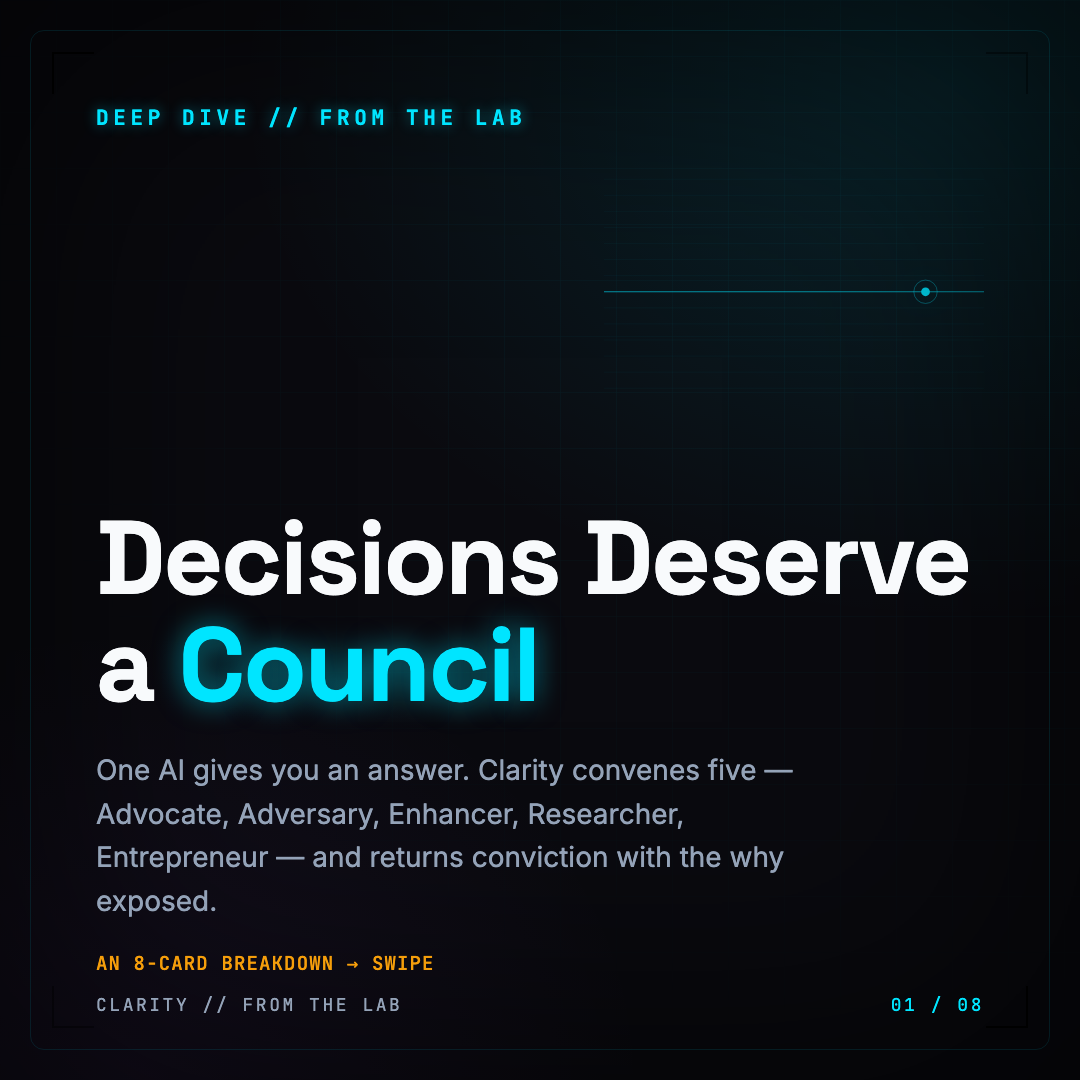
Clarity: The Decision Laboratory
One AI's answer is an average. Clarity convenes a council of five agents — Advocate, Adversary, Enhancer, Researcher, Entrepreneur — to deliberate your career decision in parallel and return conviction with the reasoning exposed.