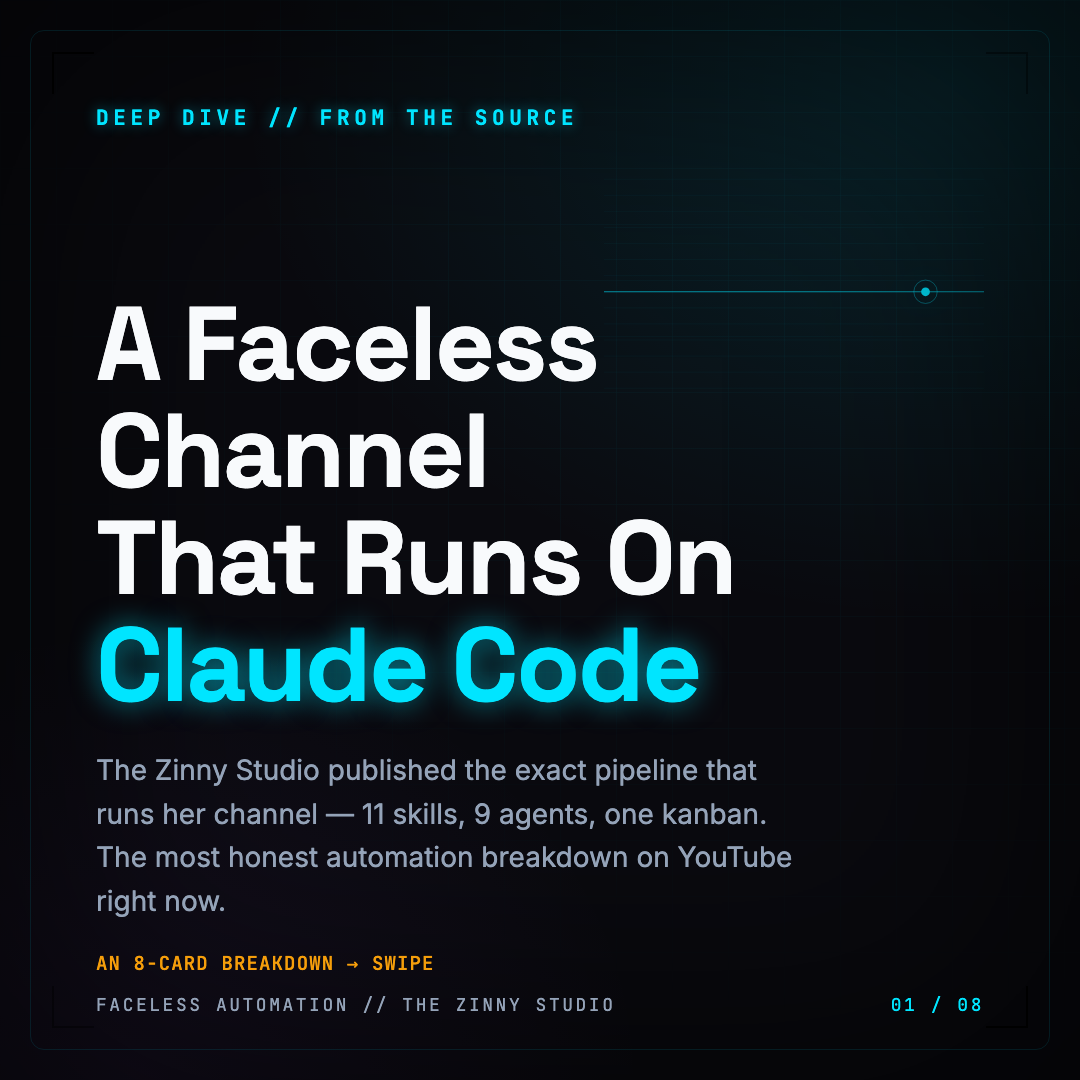
The Zinny Studio published the exact Claude Code pipeline that runs her faceless channel — 11 skills, 9 agents, and a Notion kanban with a human gate at every column. The most honest automation breakdown on YouTube right now.
 ⊕ zoom
The most honest version of the 'automate your channel' pitch on YouTube — because of what it refuses to automate. Script rewrites stay manual, publishing stays manual, and a Notion kanban holds a human gate at every column. That's the correct shape for a content system; it's the same shape I run in production. The automation does the heavy lifting — the human keeps the standards.
Source: Automate Your Entire Faceless Channel With Claude Code (Full Proof) — @thezinnystudioThe Verdict
The pipeline is wrapped in human gates and three preconditions that the money-printer crowd always skips. Skills do one focused job, agents compose skills on a schedule, and a Notion kanban moves cards through the pipeline with a human decision at every column. That's the correct shape for a content system — it's the same shape I run in production for my own channels. Worth the 36 minutes for anyone building a content pipeline, faceless or not.
Three Rules Before You Automate Anything
- Never automate something you can't do manually. — If you can't tell a strong script from a weak one, you can't tell Claude when it's wrong — you're just publishing whatever the model gives you and hoping.
- Do the end-to-end process by hand at least once. — Don't automate 90% of your workflow on day one. Saving one hour a day compounds — one today, two next month, four by end of quarter.
- Focus on the output, not the automation. — One question for everything the model produces: would you be proud to put this out under your name?
"If the answer is no, you don't have an automation problem. You have a standards problem — and no amount of tools is going to fix that."
The Seven-Stage Pipeline
Demonstrated end-to-end on a hypothetical channel ("Mia Studio") so every step is reproducible. Implemented as 11 custom skills, 9 agents, and a Notion kanban that carries state between them.
- Research — Find outlier videos in the niche, validate demand, turn signal into a list of video ideas. —
Skill + scheduled agent - Content calendar — Slot validated ideas into a publishing schedule — titles, dates, and angles locked in. —
Agent → Notion - Thumbnail design — Generate concepts straight from the video title, in the channel's brand style, from reference examples. —
Skill + image MCP - Script writing — Draft the full script in the channel voice — hook, body, CTA already structured. —
Skill, human rewrite - Voiceover + lip sync — Script → voiceover → synced to the channel avatar. —
ElevenLabs + DreamFace - Video editing — Voiceover, avatar, B-roll, and captions composed into a finished video with motion graphics. —
HTML-to-video composition - YouTube publishing — Upload with title, description, tags, and schedule pre-filled — staged as a draft, never auto-published. —
Agent, human publishes
Context Before Capability
Before a single skill exists, the workspace gets a context/ folder: reference thumbnails that are winning in the niche, the channel avatar, and a brand guide the model reads on every run — brand context, brand style (palette, fonts, visual direction), and brand voice as separate markdown files. Plus a CLAUDE.md capturing what everything in the folder is for.
Brand-as-files. Because the brand lives as files the model reads every run, every artifact comes out already on-brand — research dashboards render in the channel palette, thumbnails match the reference style, compositions use the house visual language. Nothing is styled after the fact.
Skills Are Abilities. Agents Are Schedules.
A skill is one focused job. The research skill finds outlier videos 0–60 days old in the niche, flags anything popping off within its first 5 days, and pulls signal from long-form YouTube, Instagram Reels, and X — then renders a branded HTML dashboard with five validated video ideas, hooks, angles, and risks.
An agent is skills composed on a trigger. The content-strategy agent runs the research skill every Monday and Friday at 8 a.m. via a scheduled routine and delivers the dashboard to your inbox.
The distinction. Skills don't know about time or sequencing. Agents don't know how to do the work. That separation is the whole architecture — each piece stays simple enough to debug.
The Kanban Is the Human Interface
Research lands in a Notion hub database. Checking an idea fires the next agent, which writes it onto the video-ideas board. From there: thumbnail generated → human reviews → script drafted → human rewrites it personally (no automation at this stage, deliberately) → approved → voiceover + lip sync generated → human reviews → edit → ready to upload → staged as a YouTube draft → human publishes manually.
Every column transition is an agent. Every gate is a person. The reason isn't sentiment — a fully end-to-end run gives you zero correction points, and platforms flag content that looks machine-published.
The publish gate. The upload agent stages the video with title, description, and tags pre-filled. A human presses publish. Always. Auto-publishing end-to-end is how channels get flagged — and how slop ships under your name.
Tool Honesty
Rare in this genre: the video names what didn't work. HeyGen struggles with animated characters — lip sync moved to DreamFace. ElevenLabs handles voiceover (bring your own API key). Three image models were compared live with mixed results on character consistency — one nailed it, one changed the character entirely. Higgsfield is acknowledged as expensive, with API-aggregator platforms offered as the budget alternative.
| Component | Tool | Cost |
|---|---|---|
| The brain | Claude (Pro plan works) | ~$17/mo entry |
| The editor | VS Code | Free |
| The state machine | Notion | Free tier works |
| Research signal | VidIQ via MCP connector | Existing sub |
| Voiceover | ElevenLabs API | Usage-based |
| Lip sync | DreamFace (not HeyGen — fails on animated characters) | Usage-based |
| Image / video gen | Higgsfield MCP or API aggregators | The real spend |
The Design Law
"Automation isn't about finding the perfect tool. It's about designing a system where every tool's output is the next tool's input." Skills do one focused job. Agents pull those skills together. The kanban quietly moves the cards through the pipeline while you sleep. That's the whole pattern.
What I'd Research Next
- Outlier-detection precision. — The research skill keys on 0–60-day outliers with a 5-day breakout flag. How many of those flags are real signal vs. algorithm noise you'd chase into mediocre topics?
- The one-operator ceiling. — Every gate is serial human attention. What's the realistic weekly throughput before review quality — the thing the gates exist to protect — starts degrading?
- The platform policy line. — Where is YouTube's actual enforcement boundary on automated pipelines, and is staging-then-manual-publish sufficient long-term?
- Scheduled routines as production cron. — What happens when a scheduled run fails silently? A content pipeline needs retries and failure alerts — process liveness is not pipeline health.
Your move. Do one full video manually. Then automate the single stage that hurt most. Add the kanban when you have two stages talking. The full 36-minute walkthrough: youtu.be/4DiL7ufrxbs
Where to go deeper
- The source: Automate Your Entire Faceless Channel With Claude Code (Full Proof) — The Zinny Studio
- The channel: @thezinnystudio — consistently the most reproducible Claude Code creator-workflow tutorials on YouTube
- More deep dives: jeremyknox.ai/deep-dives
Explore the Tesseract Labs Ecosystem
Follow the Signal
If this was useful, follow along. Daily intelligence across AI, crypto, and strategy — before the mainstream catches on.
Claude Fable 5: We No Longer Verify the Work — We Verify the Direction
Thariq Shihipar from the Claude Code team lays out the 3 workflow changes Fable 5 made real — and the paradigm shift underneath all of them: we no longer verify the work, we verify the direction.
Blueprint: The “Should You Build It?” Machine
Building software is free now. Knowing what to build isn't. Blueprint runs a raw idea through a 5-stage framework and answers in numbers: build it, validate first, or rethink it entirely.
Clarity: The Decision Laboratory
One AI's answer is an average. Clarity convenes a council of five agents — Advocate, Adversary, Enhancer, Researcher, Entrepreneur — to deliberate your career decision in parallel and return conviction with the reasoning exposed.