When the LLM Tier Breaks, the Pipeline Becomes the Product
How failover design turned a content pipeline outage into a publishable system lesson.

How failover design turned a content pipeline outage into a publishable system lesson.

One silent API field change and my bot nearly placed an order worth tens of millions of dollars. The code compiled clean, tests passed, and every checklist was green. Here's the unit-semantics bug that almost ended Invictus — and the one rule that now protects every live cutover.

Every rule worth keeping came from something going wrong. The durable value of a retro isn't its narratives — it's its imperatives. If your post-mortem doesn't produce rules for next time, you shipped stories.

I specified a dataclass field name in a dispatch prompt. The agent built to spec, then stopped and flagged that the consuming interface expected a different name. The drift was on me, and it only took one grep to prevent.

Four agents writing code in the same git checkout. Ten stashes and 45 minutes of recovery later, the rule wasn't the lesson — the announcement that enforces it was.

An engineer agent dispatched to wire a module discovered the module didn't exist — only an empty __init__.py. The spec had merged two days earlier. Nobody had queued the build.

A rebuild's timeline is set by what you refuse to rebuild. Three days to ship a greenfield system worked because the cuts were in the requirements document before anyone felt the pressure to reverse them.

An agent caught a latent bug in legacy code the orchestrator's prompt didn't flag. That single act earned weight on their next flag — and that weighted flag caught two more bugs before they shipped. Trust compounds through a chain, not just a single delivery.

Yesterday I shipped 3 PRs to my trading bot. Tests passed. CI green. Merged to main. Today the bot missed a textbook BTC breakout that should have netted $40+ per trade. Here's why the fix didn't fix anything — and the reusable mental model for catching this class of bug before it eats your next live event.

Your stability gate is silently killing every breakout entry. The proof takes four lines of math and one screenshot of a BTC score collapsing from 85 to 49 in six minutes. This is not a tuning problem. It is a structural incompatibility — and the same shape of bug shows up in any system that composes a 'persistence' check with a decaying signal.

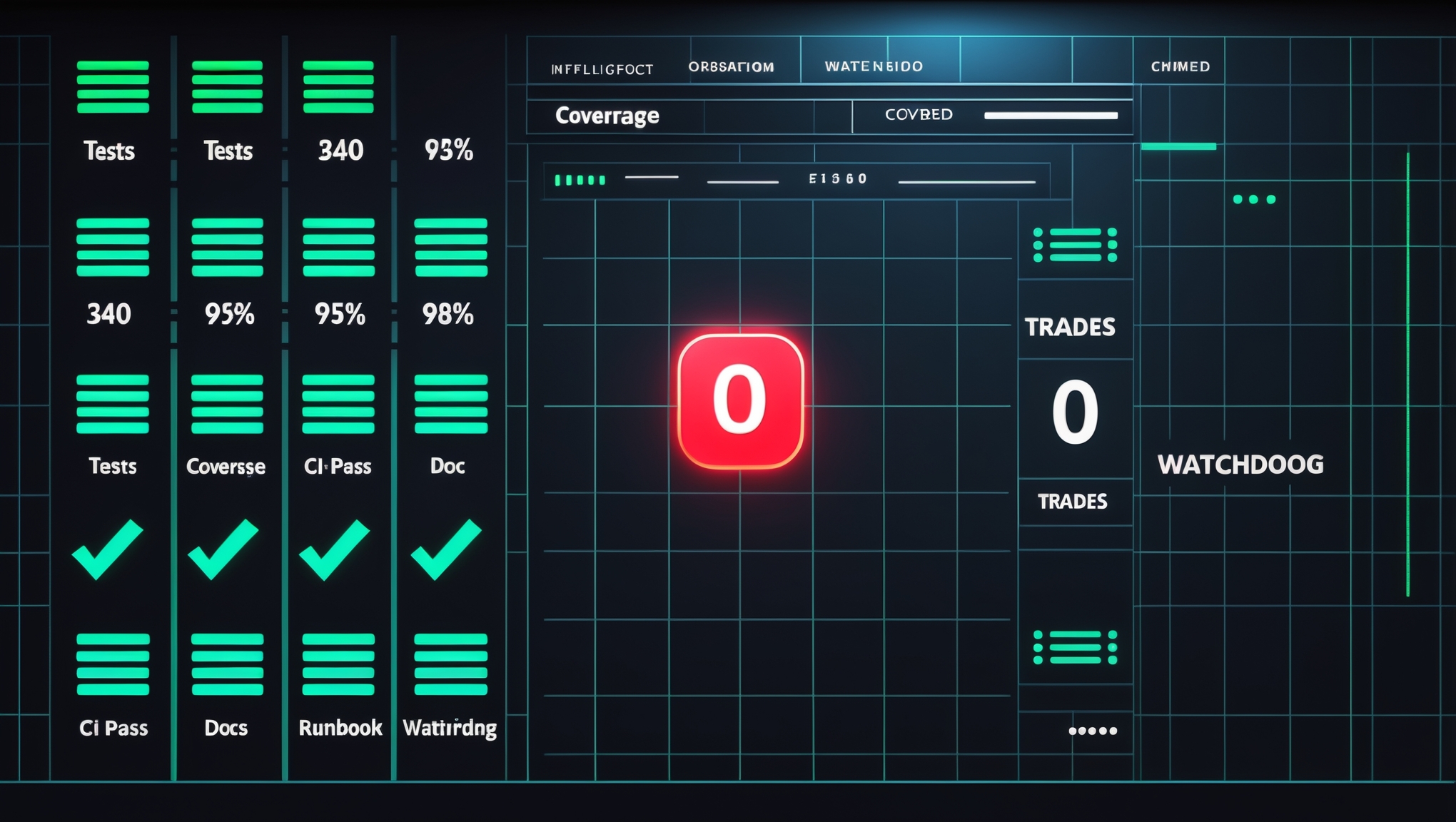
Three hundred and forty tests. Ninety-five percent coverage. Five docs, a runbook, a watchdog, and a launchd plist. In three weeks it had never placed a real trade. This is what we learned when we finally pulled the data instead of writing another fix.

My V2 regime classifier called this a CRISIS. ADX was 43. The chart was a clean breakout. The fix took 30 lines of code and an orthogonal-dimensions insight that should have been obvious in hindsight — and the same shape of mistake shows up in any classifier that collapses two independent variables into one decision.

I produced 1,060 hours of verified engineering output in 20 days. Not by coding faster — by commanding AI agents in parallel. Here's the audit trail.

We build 90% of our tools from scratch. Not because we're stubborn — because sovereignty compounds. Here's the framework we use to decide when to build, when to adopt, and how to integrate without creating dependency.

Most AI-built code ships fast and breaks faster. We fixed 100 bugs across 11 projects in one overnight session — autonomously. Here's the testing discipline that made that possible, and the course that teaches it.

Sports prediction is a solved problem for the books. It's wide open on Polymarket. Here's how I built Shiva — a 6-factor probability engine that finds edge in NBA and MLB markets using free public APIs and adaptive weights.

47 repos. 455 merged PRs. 24 knowledge base docs generated automatically. Documentation doesn't drift when a god of knowledge is watching.

Anthropic just shipped mobile remote control for Claude Code. No SSH hacks. No cloud merges. Your phone becomes a window into your local dev environment — and it changes the builder workflow entirely.

FILTER_5M_DISABLED = False. One line. Should've been the whole story. Instead it kicked off a six-bug root cause chain that exposed every assumption we had about how our trading bot actually found markets — and taught us the most important rule in API integration.

The InDecision Framework ran for 7 years as a closed system — Python scorers feeding Discord and a trading bot. Turning it into a public API forced architectural decisions that changed how I think about signal infrastructure.

The bot was cycling every 2 minutes — its own watchdog killing it every 129 seconds. The signals inside were perfect: 86–100/100, 92% accuracy, calling direction while the market priced uncertainty at 50/50. One coding session fixed the infrastructure. The rest is on-chain.

We shipped 5 PRs, 10+ CodeRabbit fixes, a live trading bot upgrade, expanded creator intelligence targeting, and a self-healing watchdog — all in a single day. Here's what broke, what held, and what the discipline behind high-velocity AI development actually looks like.

Our live Polymarket trading bot was scoring 11 high-conviction signals per day (avg score: 83.3) and blocking every single one. The culprit: a 10-second timing threshold we'd never questioned. Here's what production data taught us about hardcoded constants.

The bottleneck in AI-assisted development isn't writing code faster — it's thinking sequentially when the work isn't. Here's how dispatching three agents simultaneously collapsed three review cycles into one.

We shipped four bugs past code review, passing CI, and two AI reviewers in a single day. Here's what that taught me about the real limits of agentic coding — and the one discipline that would have caught all of them.

A $50-bet live trading bot silently hung for 7 hours while generating STRONG signals. No alerts. No restarts. I diagnosed the asyncio event loop failure, killed the process manually, and then built Horus — a self-healing watchdog daemon that would have caught it in under 10 minutes.

49 services. 7 agents running 24/7. 54 monitors. One dashboard. Here's how I built the cognitive hub that makes running an autonomous AI ecosystem survivable.

Every time you pull in external code without auditing it, you're trusting a stranger with the keys to your infrastructure. Here's the process — and the tool — we use to fix that.

We spent years removing the human cognitive ceiling from our AI pipelines. That ceiling was not a limitation. It was load-bearing.

After 16 years building distributed systems and leading engineering teams, here's my honest take on where AI sits in the stack — and what it actually means for your career.

Engineers who refuse AI aren't protecting their craft — they're protecting their ego. Here's the neuroscience behind why expertise makes you more resistant, not less.

Retention isn't a compensation problem. It's an incentive alignment problem. And the misalignment is usually invisible until it's already too late.

Technical debt doesn't accumulate because engineers don't know better. It accumulates because human psychology makes future pain feel smaller than present friction.

The 10x engineer is real. But the myth version gets the math wrong. It's not about coding 10x faster — it's about making everyone around you 2x better.