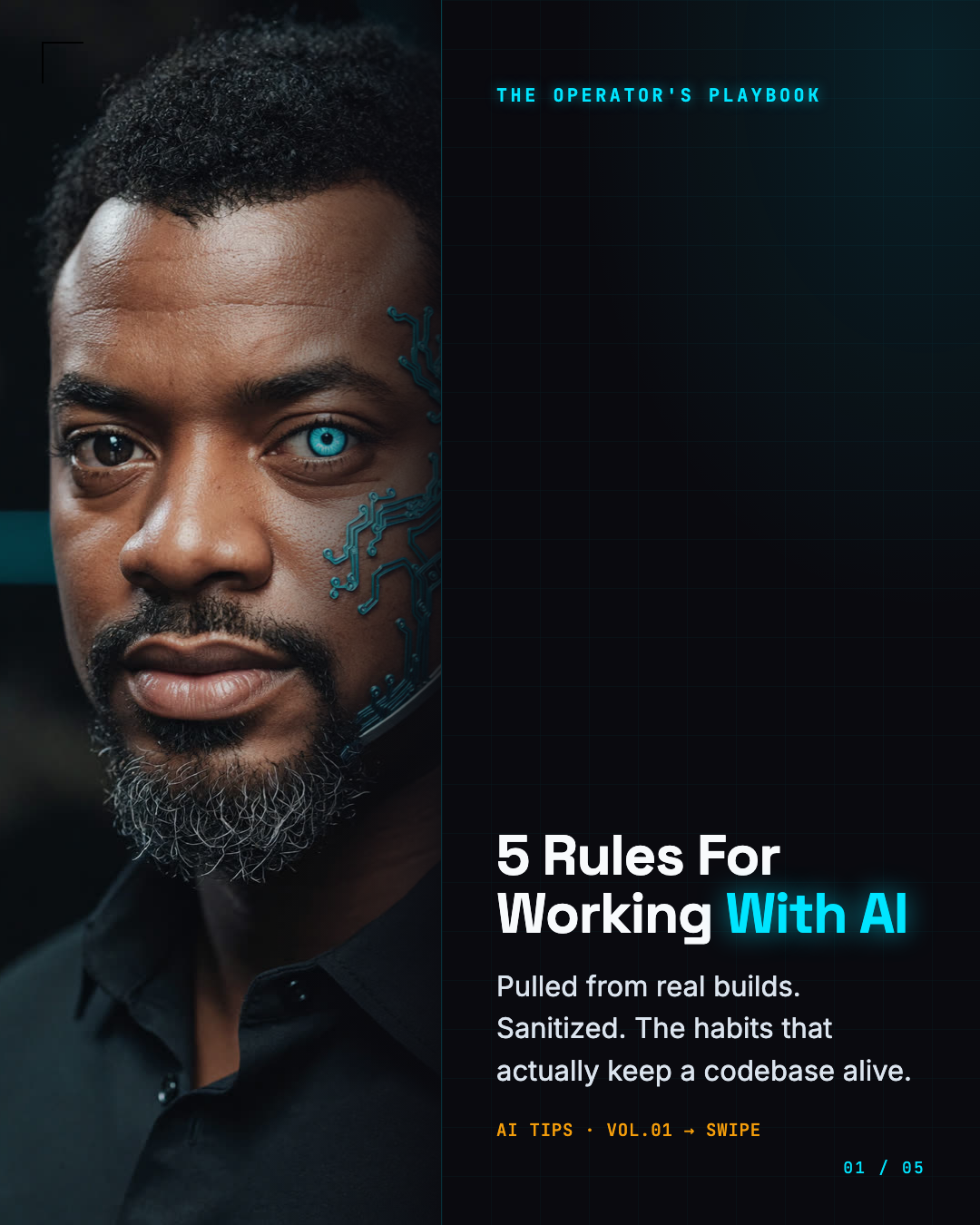
Five habits — pulled from real production builds and sanitized — that keep an AI-assisted codebase alive instead of quietly rotting it. The rules behind the graphics.
 ⊕ zoom
The model is a force multiplier, not a replacement for judgment — scope every prompt, stop when it thrashes, and never let it hold the whole project at once.
AI optimizes for 'helpful,' not for 'minimal' or 'correct.' These five habits put the judgment back where it belongs: with you.
Most people lose the plot with AI the same way — they hand it the whole problem, accept whatever comes back, and act surprised when the codebase quietly rots. The fix isn't a better model. It's a tighter operating loop. Here are five rules I run in production, sanitized down to the part that travels.
1. End Every Prompt With One Line
Close every change request with a single sentence: "Fix only these items. Change nothing else."
Without it, the model "helpfully" rewrites working code you never asked it to touch — renaming variables, re-flowing logic, "improving" the file out from under you. The one-liner turns an open-ended edit into a bounded one.
Why it works: the model optimizes for helpful, not for minimal. You have to draw the box, or it fills the whole canvas.
2. Stop After Two Failed Attempts
If the same fix fails twice, stop. Do not run it a third time with slightly different words. Re-plan from the assumption that's wrong — the bug is almost never where you've been pushing.
Why it works: thrash compounds. Two failures is signal, not noise — it means the approach is wrong, and a wrong approach won't fix itself with another lap.
3. One Feature, One Conversation
Never ask AI to hold an entire multi-feature build in a single thread. Decompose first: isolate one feature, give it the minimal context, verify it works, then integrate the next one without disturbing what's already done.
Why it works: context overload is a quality regression. A model juggling the whole project gets vaguer with every turn — small, verified increments stay sharp.
4. Build The Test Before You Trust The Output
For anything that matters, write the check first — a test, a known-good example, a "this is what right looks like." Then let the model work against it. A green check is the difference between it ran and it's correct.
Why it works: a passing demo proves nothing about the next input. The test is what catches the model when it's confidently wrong.
5. Pin The Reference — Don't Let AI Reinterpret It
When you're matching a design, a spec, or an existing pattern, lock the reference: "This is the only source of truth. Do not redesign, simplify, or reinterpret it." Then give feedback that's specific and measurable, not vibes.
Why it works: unconstrained, the model drifts toward its own averages. Pinning the reference keeps it building your thing instead of a plausible-looking substitute.
The throughline: every rule moves judgment back to you. The automation does the heavy lifting — you keep the standards. That's the whole game.
Explore the Tesseract Labs Ecosystem
Follow the Signal
If this was useful, follow along. Daily intelligence across AI, crypto, and strategy — before the mainstream catches on.
The Model Gets Replaced. The Manual Doesn't.
I had the strongest model on my account write the operating manual its replacement runs on. Eight procedures. Any model. Yours to steal.

How One Operator Out-Ships A Team (5 Rules)
Five rules for running like a one-person army — the leverage habits that let one operator with the right tools out-execute a whole team. The rules behind the graphics.