LangGraph vs CrewAI vs Claude Code: Picking an AI Agent Framework
Feature tables don't tell you which AI agent framework to use. The coordination model does — explicit state graph, role-based crew, or one capable agent with skills.

Feature tables don't tell you which AI agent framework to use. The coordination model does — explicit state graph, role-based crew, or one capable agent with skills.

Agentic RAG explains how an agent retrieves external knowledge mid-task. It doesn't explain what happens when the session ends and the next one starts from zero. That's an AI agent memory problem, and it's a different problem.

A Reddit thread ranking #1 for the exact question — what tools to use to build AI agents — is mostly vendor noise. Here's the actual AI agent tech stack running 325 agents in production, layer by layer.

Everyone teaches building agents. Almost nobody teaches running ai agents in production — the operational discipline that separates a demo from a fleet that survives contact with reality.

Claude Code skills look like small individual commands until you stack them — then quality-check, verify, and five others become the pipeline that gates every merge across a 325-agent fleet.

If you searched how to start building AI agents and got a slide deck instead of a starting point, this is the practitioner's version — the order to learn things in, and the one small agent worth shipping first.

Anthropic's most powerful model just shipped, and the most instructive reaction came from someone who didn't rebuild anything. Nate Herk spent the day slotting Fable into the AI OS he'd already built — folders, markdown, and the Four Cs. That's the lesson.

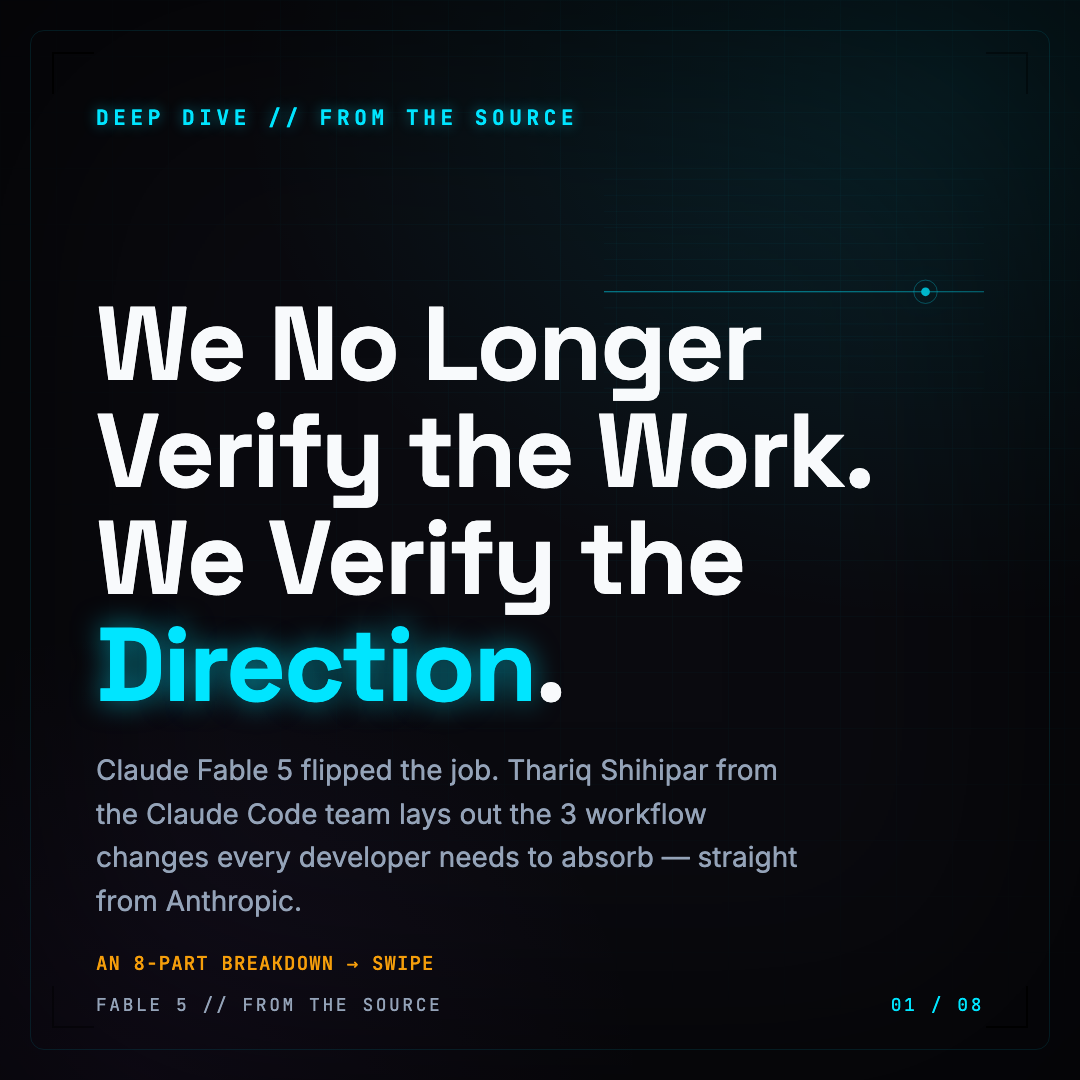
Thariq Shihipar from the Claude Code team lays out the 3 workflow changes Fable 5 made real — and the paradigm shift underneath all of them: we no longer verify the work, we verify the direction.

Prompt-engineering is already obsolete. The new unit of work is the skill — a folder with three layers, only one of which most people bother to build. The leverage lives in the layer they skip.

Every Claude Code session starts from zero — no memory of your standards, gates, or the three bugs that bit you last sprint. The Skills Library changes that. 19 slash commands. Institutional discipline, without the briefing.

Every rule worth keeping came from something going wrong. The durable value of a retro isn't its narratives — it's its imperatives. If your post-mortem doesn't produce rules for next time, you shipped stories.

I specified a dataclass field name in a dispatch prompt. The agent built to spec, then stopped and flagged that the consuming interface expected a different name. The drift was on me, and it only took one grep to prevent.

Four agents writing code in the same git checkout. Ten stashes and 45 minutes of recovery later, the rule wasn't the lesson — the announcement that enforces it was.

An engineer agent dispatched to wire a module discovered the module didn't exist — only an empty __init__.py. The spec had merged two days earlier. Nobody had queued the build.

An agent caught a latent bug in legacy code the orchestrator's prompt didn't flag. That single act earned weight on their next flag — and that weighted flag caught two more bugs before they shipped. Trust compounds through a chain, not just a single delivery.

One YouTube video, one insight, one session. What started as a note about persistent agent expertise turned into a full agent operations platform: 22 specialist roles, behavioral health monitoring, directive lifecycle tracking, and an E2E proof that closed in 8 minutes.

I produced 1,060 hours of verified engineering output in 20 days. Not by coding faster — by commanding AI agents in parallel. Here's the audit trail.

The bottleneck in AI-assisted development isn't writing code faster — it's thinking sequentially when the work isn't. Here's how dispatching three agents simultaneously collapsed three review cycles into one.

Claude Code can now turn production code into editable Figma designs — and round-trip the changes back. This isn't a designer's tool. It's a fundamental change to the design-engineering handoff that engineering managers need to understand before their teams figure it out for them.