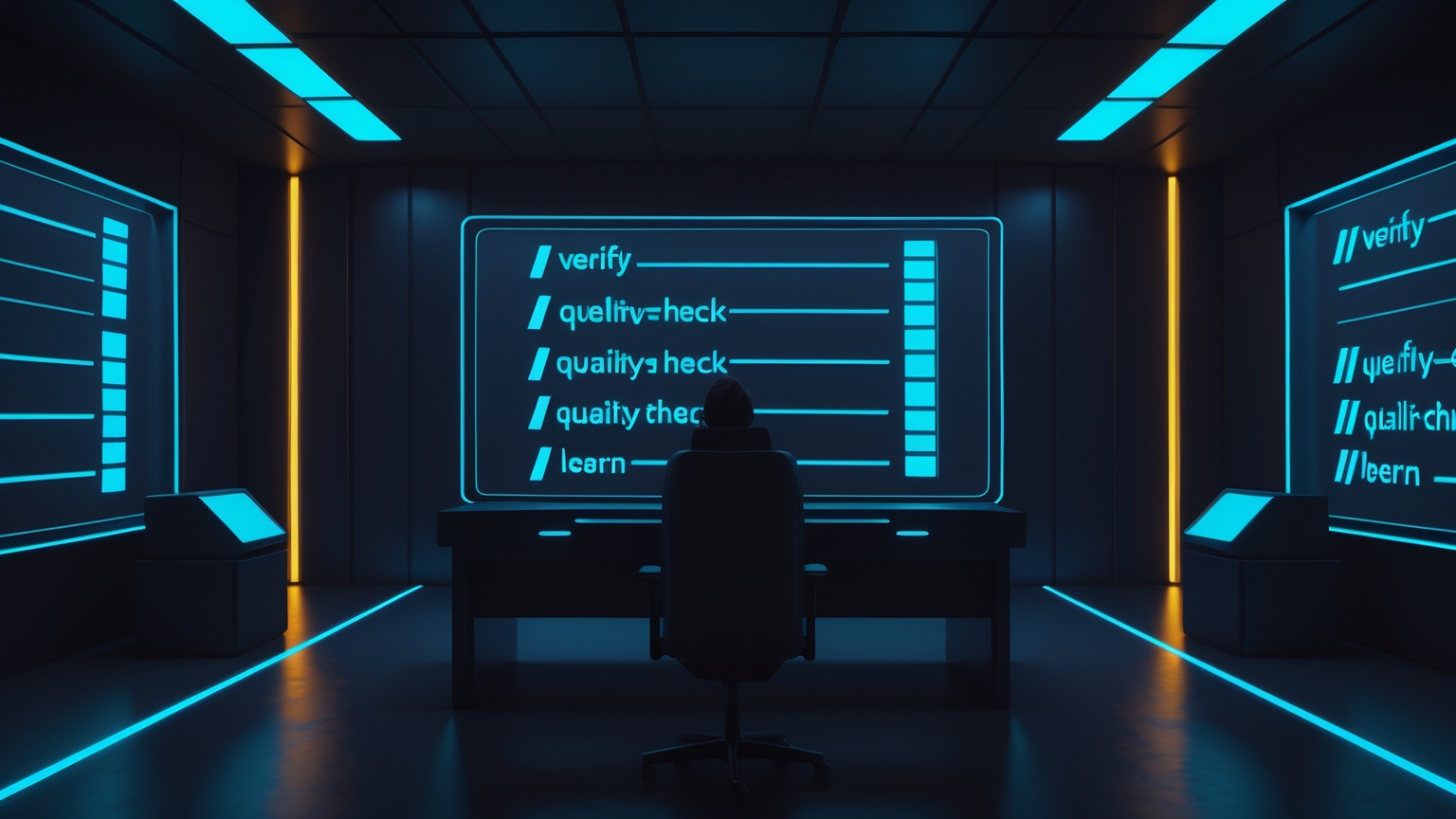
Every Claude Code session starts from zero — no memory of your standards, gates, or the three bugs that bit you last sprint. The Skills Library changes that. 19 slash commands. Institutional discipline, without the briefing.
 ⊕ zoom
Every time you open a new Claude Code session, you start from zero.
The AI doesn't remember that you got burned by a secrets leak in March. It doesn't know you require 80% coverage before merge. It doesn't know your stack, your conventions, your gate requirements, or the three things that have bitten you on the last five PRs. You either re-explain all of that upfront, paste in your CLAUDE.md and hope it reads it, or you skip it and trust that this session will somehow be different.
That's the statefulness problem. And most teams are solving it wrong.
They're writing longer and longer CLAUDE.md files, trying to cram institutional memory into a context window. They're pasting the same instructions into every session. They're accepting the cognitive tax of re-orienting an AI that has no continuity as just the cost of working with these tools.
I built a different system. It's called the Skills Library, and it just shipped.
What a Skill Actually Is
A skill is not a prompt. It's a protocol.
A prompt is what you type. A skill is a structured instruction set — a .md file that defines an agent's execution model, its available tools, its output format, and its upgrade hooks. You drop it into your Claude Code project once, invoke it with a slash command, and it runs the same way every time.
The difference matters because prompts drift. You write a slightly different prompt on Tuesday than you did on Monday. You forget a step under pressure. You leave out the security scan because you're in a hurry. Skills don't drift. They enforce the same protocol every session, every project, every engineer on the team.
A skill is how you make an AI behave like an engineer who already knows your standards — not a contractor who needs a full briefing every time they walk in the door.
We shipped 19 skills in the first drop. Seven are free. Twelve are Pro and Elite. Here's the architecture and the reasoning behind every decision.
The Free Tier: Seven Skills for Diagnosis
The free tier is deliberately limited to diagnosis. Single agent. Read-only or minimally invasive tools. No auto-fix. No PR automation.
That limitation is a feature, not a constraint.
When you give an AI the power to auto-fix and auto-merge, you need a high degree of confidence that it knows your standards. That confidence comes from experience with the tooling — from running the diagnostic version first, seeing how it categorizes risk, seeing what it flags. The free tier builds that trust. When you're ready for the Pro tier to write your tests and fix your P0 issues, you already know exactly what it's going to do because you've seen the analysis layer dozens of times.
Here's what the seven free skills cover:
/quality-check — Runs your test suite, maps your riskiest untested paths, ranks the top 5 by real risk (auth, payments, data writes first — not by line count), flags security gaps, produces a PASS / CLOSE / NEEDS WORK verdict. This is the skill you run before you touch a codebase you haven't seen in three weeks.
/verify — Full pre-PR gate: build → lint → test → secrets scan. Single PASS / CLOSE / FAIL verdict. The rule: run this before every push, not after. CI is a public scoreboard. Verify is the private rehearsal.
/debug-investigate — Scientific method for debugging. Maintains a hypothesis log that prevents re-investigating dead ends across the same session. Every hypothesis recorded: what we thought, what we tested, what we found. The next engineer who picks this up — human or AI — doesn't start from zero.
/scaffold-tests — Detects your stack, installs the right testing framework if it's missing, writes real tests with real assertions (not just "function runs without error"), sets up CI, verifies the suite passes. Zero to test suite in one command.
/pressure-test — Adversarial premortem and blind spot analysis on any plan, PRD, or idea. The only free skill with zero technical prereqs. Five checks, one verdict: kill or proceed with conditions. You find out in 10 minutes what would have taken a week to discover after the first PR.
/build-fix — Runs your build, isolates the root failure from cascade noise, traces it to a specific file and line, proposes one targeted fix. Not a list of things to try — the most likely correct fix, with reasoning, then a re-run to confirm.
/learn — Extracts the non-obvious patterns from a coding session into a structured lessons.md entry before the context window closes. Mistake → root cause → rule. Escalation check included: if the pattern has appeared before, it flags for CLAUDE.md promotion. Free members get local file storage. Pro members plug this into a persistent second brain so findings survive across sessions, machines, and agents.
The conversion hook is built into the skill itself. Every free skill ends with a specific, accurate description of what the Pro version adds — not vague upgrade language, but an exact capability delta. You know precisely what you're missing before you decide whether it's worth it.
The Pro Tier: Multi-Agent Orchestration
The free tier diagnoses. The Pro tier fixes.
Nine skills. Multi-agent orchestration. Auto-fix enabled. Every Pro skill includes second brain hook comments — placeholder integration points for querying and writing to your knowledge base before and after each step. The skill gets smarter on your codebase over time as the knowledge base fills in.
/quality-team — Three parallel agents: Coverage Analyst feeds Test Writer and Code Reviewer simultaneously. Test Writer writes the tests for every Critical gap. Code Reviewer fixes P0 security issues inline — not documented for later, fixed now. This is what /quality-check diagnoses; /quality-team treats.
/feature-team — Three agents (Backend Dev + Frontend Dev + QA) with defined file territories, implementing from a PRD in parallel. The territory boundaries matter — this is how you run parallel agent work without merge conflicts. I learned that lesson the hard way.
/auto-fix — Classifies runtime failures (crash / memory leak / dependency / config / network), traces root cause through indirection to the originating line, implements a targeted minimal fix, runs tests, redeploys, verifies recovery via health check, writes an incident report. The free /build-fix handles compile errors. Auto-fix handles the failures that happen after you ship — at 2am, while you're asleep.
/prd-writer — Converts an idea or problem statement into a structured PRD: problem statement, explicit scope with non-goals, functional requirements written as user-facing behaviors, measurable success criteria, open questions with owners and deadlines. The output feeds directly into /feature-team. The pipeline: pressure-test the idea (free) → prd-writer (pro) → feature-team (pro).
/ci-wait-and-merge — Blocks on CI completion, polls for PR review comments, implements fixes for nits, auto-merges when green. This is the skill that closes the loop /verify opens. You push, verify told you it was clean, ci-wait-and-merge handles everything after.
/research-team — Parallel research agents that gather prior art, validate technical approaches, surface risks, and synthesize findings into a structured brief before you build. The output becomes the context for /prd-writer or /feature-team.
/document-swarm — Three specialized documentation agents running in parallel: API documenter, architecture documenter, and README writer. Each has a distinct file territory. No overlap, no diffusion. Run it after any significant feature ship.
/frontend-design — Accessible, production-quality UI implementation. Enforces design system compliance, contrast ratios, semantic HTML, and keyboard navigation. Reviews against your design-system/MASTER.md before touching any component.
/context-budget — Audits your active Claude session's context consumption. Ranks the top 5 consumers by estimated token cost, scores each against value delivered (high cost + low reference = trim candidate), produces a concrete trim list for the next session, and estimates remaining runway. Run it before you hit saturation, not after.
The Elite Tier: Full Pipeline Orchestration
The Elite tier is where individual skills become pipelines.
/audit-swarm — Six parallel domain audits: security, architecture, performance, naming, contract, and configuration. Findings ranked by severity. P0s and P1s fed directly into /audit-swarm-resolve, which dispatches fix agents, runs tests, and opens PRs. This is the overnight autonomous audit I run across the full project portfolio — a whole-codebase health sweep while I sleep.
/security-team — Multi-agent security review: OWASP Top 10 scan, dependency audit, secrets detection, authentication flow analysis, and injection risk mapping. Produces a ranked finding report with severity classifications and fix recommendations. Required gate before any new auth surface ships.
/incident — Full P0 incident response protocol. Timeline assembly, stakeholder communication chain, root cause investigation, mitigation steps, recovery verification, and blameless post-mortem. The distinction matters: /auto-fix is for autonomous resolution of classifiable runtime failures. /incident is for P0 events that require human coordination, timeline documentation, and post-mortem output.
The Elite tier is not for engineers who want more features. It's for operators who want to stop managing individual tasks and start managing pipelines. The shift from task to pipeline is the shift from using AI as a coding assistant to running AI as an engineering team.
The Second Brain Problem
Here's what the free tier teaches you and the Pro tier solves.
Every session, you lose context. You forget what you decided last week. You re-investigate dead ends. You re-explain your architecture to an AI that has already seen it three times. The cognitive cost of context reconstruction is invisible until you add it up — and then it's enormous.
The second brain hooks in every Pro and Elite skill are the structural answer to this. Before each phase: query your knowledge base for what you know about this project. After each phase: write what you learned. The AI that runs /feature-team next week knows about the pagination bug you hit this week because the skill wrote it down.
The free /learn skill builds the habit. It writes to a local lessons.md. That file is the seed of a second brain you don't have yet — the visible proof that capturing context is worth doing before you invest in the infrastructure to do it properly.
/learn is a Week 6 drop, not a Week 12 drop. You want to establish that habit when the system is still new — not after six weeks of running skills that don't persist anything and wondering why each session still feels like starting over.
How the Distribution System Works
Every skill has a dedicated article at jeremyknox.ai/skills-library/{slug}. The article makes the case for the skill — the problem it solves, what it does and what it explicitly does not do, the exact output format, the upgrade delta. The skill file itself is downloadable at the bottom, gated by tier.
Free skills: no auth required, instant download.
Pro and Elite skills: role-gated through the Academy membership system. Your membership tier determines which skills unlock automatically.
The Discord community has a dedicated #skills-library channel with a pinned post for every skill drop — hook, feature summary, slash command, and direct download link. An indexed, searchable archive of the full library that follows the same drop calendar as the website.
Seven skills are live now. The remaining twelve drop weekly.
What This Is Actually About
The statefulness problem I opened with doesn't go away by itself.
Every session starts fresh. Every fresh session is an opportunity for an AI to miss your standards, skip a gate, or not know about the class of bug that burned you last month. Most teams are managing this through repetition — re-explaining, re-orienting, re-establishing context manually every time.
Skills are the alternative. Not a CLAUDE.md that grows to 800 lines trying to be everything at once. Not a prompt you paste in and hope doesn't get ignored. A defined protocol that enforces the same behavior every time, with upgrade hooks that get smarter as your knowledge base grows.
Be brilliant in the basics. Advanced skills are built on a mastery of fundamentals.
— James Mattis · Call Sign Chaos
The quality gate isn't where you slow down. It's where you stop shipping the same bugs and start shipping standards.
Stateless sessions are a constraint. Stateless discipline is a choice.
The Skills Library is at jeremyknox.ai/skills-library. Seven free skills available now. Drop calendar runs weekly. Start with /quality-check — it'll tell you exactly where your codebase stands in about two minutes.
Go Deeper
The skills system is documented at the Academy level in the Quality Engineering track — test strategy, coverage discipline, pre-PR gates, and the delivery checklist that underlies every free skill in this library.
The article tells you what the skills do. The Academy teaches you the engineering discipline behind why they work.
Browse the Skills Library → Start the Quality Engineering track →
New to Claude Code? The Getting Started track takes you from zero to your first project in 8 lessons. 8 lessons.
Start the Getting Started with Claude Code track →Explore the Tesseract Labs Ecosystem
Follow the Signal
If this was useful, follow along. Daily intelligence across AI, crypto, and strategy — before the mainstream catches on.

5 AI Agent Design Patterns That Survive Production
Tool-use, planning, multi-agent handoff, human-in-the-loop escalation, and verification gates — the five AI agent design patterns everyone teaches — look identical in a course slide. Under real traffic they behave nothing alike, and each one guards against one specific failure.

AI Agent Observability: Monitoring 325 Agents Without Watching Them
Real ai agent observability isn't a wall of dashboards you stare at — it's decision logs, staleness signals, and thresholds that only page a human when something actually needs one.

The AI Agent Tech Stack Behind 325 Agents in Production
A Reddit thread ranking #1 for the exact question — what tools to use to build AI agents — is mostly vendor noise. Here's the actual AI agent tech stack running 325 agents in production, layer by layer.