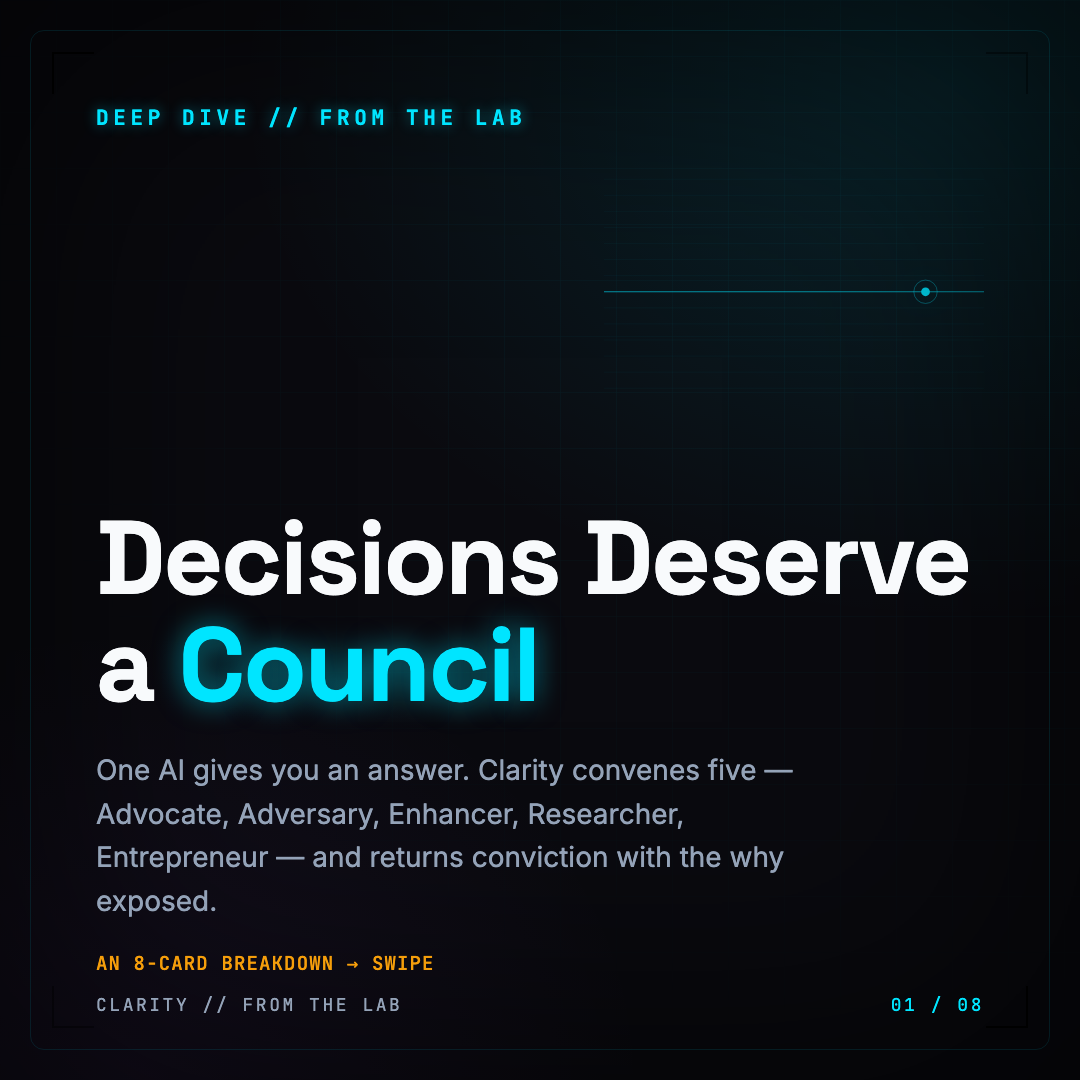
One AI's answer is an average. Clarity convenes a council of five agents — Advocate, Adversary, Enhancer, Researcher, Entrepreneur — to deliberate your career decision in parallel and return conviction with the reasoning exposed.
 ⊕ zoom
Full disclosure: I built this — so judge Clarity by the only test that matters: when I face my own next high-stakes call, do I bring it to the council before I decide? I do. An answer is an average; a deliberation takes positions. The career decisions that shape a life deserve more than one voice.
Source: Clarity — A Decision Laboratory — Jeremy KnoxThe verdict
Full disclosure: I built this. So judge it by the test it has to pass: when I face my own next high-stakes call, do I bring it to the council before I decide? I do. Clarity exists because the most expensive career mistakes aren't made from missing information — they're made from missing perspectives.
Why this matters
The pivot, the raise, the leap you keep postponing — these aren't information problems. ChatGPT gives you a hedged answer. Friends are biased toward your comfort. Coaches are expensive and slow. What's missing is a framework for thinking: multiple genuine perspectives, forced to take positions, reconciled into one verdict you can act on.
A single AI answer is an average. A deliberation takes positions. Clarity's design bet is that the structure of disagreement — not more data — is what produces conviction. The site says it plainly: conviction, not hedging.
The council — five agents, zero hedging
Six of Clarity's seven modes run a five-agent council in parallel, then a synthesizer reconciles them into a verdict: a conviction score (0–100), a risk inventory, an action plan, and an agent-alignment readout showing where the council agreed — and where it split.
- The Advocate — Builds the strongest honest case for the move. Its prompt explicitly bans the cop-out: "might work if everything goes perfectly" is not a position — it's a hedge dressed as advocacy.
- The Adversary — Precise, specific caution. Vague warnings ("this seems risky") are called out in its instructions as filler, not analysis.
- The Enhancer — Doesn't judge the plan — upgrades it, and flags the execution risks that could sink it during implementation.
- The Researcher — Facts only, with anti-fabrication rules: it may not embellish your own biography. Inflating "in this field since 2010" into "deep domain mastery" is treated as fabrication, same as a fake salary number.
- The Entrepreneur — Reframes the decision itself. Its key question interrogates whether you've even defined the right decision.
The flow — three minutes in, conviction out
- Describe your situation — Your words, no template — the decision, the tension, the thing you keep circling back to.
- Answer five questions — Non-negotiables, your fear, your definition of success in 12 months — so the council argues against your situation, not a generic proxy.
- The council deliberates — Five agents in parallel, each with an adversarial mandate and a banned list of cop-outs.
- Synthesis — One verdict reconciling the five — with a risk inventory and an action plan attached.
- Conviction score — 0–100, with an agent-alignment readout showing exactly where the council agreed and where it split.
- Follow-up — Push back on the verdict — the council answers in thread.
Seven rooms — six deliberations and a Vent
Each mode frames a different class of decision, and each seats its own lead agents: Career Pivot ("where the next chapter requires a different protagonist"), Inflection Point ("a fork that locks in more than it names"), Negotiation ("a single conversation with an unbounded afterlife"), Market Timing ("where waiting is also a position"), plus Side Hustle and Network Play.
The seventh, Vent, isn't a deliberation at all — it's a sequenced Listener → Reframer → Strategist flow for when you need the clearing that honest deliberation requires.
Two registers
The same council, two postures. Therapist mode is calm and contemplative — for decisions that produce anxiety, not clarity; you leave feeling held, not hectored. Coach mode is direct and kinetic — for when you know the direction and need the push and the plan.
Context depth — a council that learns you
- Sketch — First session — advice calibrated to what you shared today.
- Briefed — Intake complete — the council knows your non-negotiables, fears, and success definition, so advice fits the shape of your career, not just this decision.
- Witnessed — You've returned over time — the council has seen how you decide, reads patterns, and surfaces recurring tensions.
Privacy is engineered in
Decisions are confessions — people won't bring honest input to a system they don't trust. So the trust layer is structural, not a policy page:
- Per-user encryption — Every decision is encrypted with per-user keys at the application layer — not just at rest.
- Voice deleted in 60 seconds — Recordings are destroyed within a minute of transcription.
- Vent is sacred — Vent transcripts are treated as the most sensitive data in the system.
- Default-deny database — Row-level security on every table; a crisis-detection safety layer watches for moments that need more than a council.
- Public commitments — The promises are in writing at the Trust Center — not buried in a ToS.
How it's built
Next.js App Router + TypeScript frontend, Supabase Postgres with row-level security and per-user envelope encryption, Vercel behind a WAF, Claude doing the deliberating with prompt caching, server-side voice (Deepgram in, ElevenLabs out) on the top tier, Stripe for billing.
| Tier | Price | What you get |
|---|---|---|
| Free | $0 | 3 decisions/mo · full five-agent council · every mode · both registers |
| Standard | $19/mo | 10 decisions · decision history · pattern insights · follow-up threads |
| Premium | $39/mo | 20 decisions · image & document upload · priority deliberation |
| Elite | $99/mo | 150 decisions · voice intake & spoken verdicts · deepest personalization |
What I'd research next
- Does the council actually disagree? — Measure the alignment distribution across real deliberations. If alignment always lands above 80%, the Adversary isn't earning its seat — the honest version of this product publishes its disagreement rate.
- Verdict calibration at 6–12 months — Did people who followed the synthesis report better outcomes than those who didn't? Conviction scores need a hit rate, same as any forecast.
- The register effect — Run the same situation through Therapist and Coach — does the register change the decision or just the experience? If verdicts diverge, that's signal.
- Witnessed-depth anchoring — Accumulated context sharpens advice — but when does "knows how you decide" become "anchors on how you used to decide"? Long-term memory needs a forgetting policy.
Where to go deeper
Bring a decision at clarity.rewiredminds.io — 3 free decisions a month, full council, no card required. The editorial home behind it is rewiredminds.io, and more dives like this live at jeremyknox.ai/deep-dives.
Money quote. "The career decisions that shape a life deserve more than one voice."
Explore the Tesseract Labs Ecosystem
Follow the Signal
If this was useful, follow along. Daily intelligence across AI, crypto, and strategy — before the mainstream catches on.
Claude Fable 5: We No Longer Verify the Work — We Verify the Direction
Thariq Shihipar from the Claude Code team lays out the 3 workflow changes Fable 5 made real — and the paradigm shift underneath all of them: we no longer verify the work, we verify the direction.
A Faceless Channel That Runs on Claude Code
The Zinny Studio published the exact Claude Code pipeline that runs her faceless channel — 11 skills, 9 agents, and a Notion kanban with a human gate at every column. The most honest automation breakdown on YouTube right now.
Blueprint: The “Should You Build It?” Machine
Building software is free now. Knowing what to build isn't. Blueprint runs a raw idea through a 5-stage framework and answers in numbers: build it, validate first, or rethink it entirely.