Five rules for running like a one-person army — the leverage habits that let one operator with the right tools out-execute a whole team. The rules behind the graphics.
 ⊕ zoom
Leverage was never headcount — it's one operator who owns the system, points the tools at the work, and keeps the judgment for themselves.
Tools collapse what used to take a team. What's scarce now isn't hands — it's the standards and the framework you bring to the work.
The story that keeps circulating: a company's entire marketing function, through a stretch of fast growth, run by essentially one person. People assumed an agency. Or a hidden team. The more likely explanation is simpler — one operator who knew the system, pointed the right tools at the work, and kept the judgment for themselves. Whether or not the anecdote is exact, the pattern it points at is real — and it's the new shape of the work. Here are five rules that make it repeatable, pulled from real builds and sanitized down to the part that travels.
1. One Operator Beats The Whole Team
Leverage used to mean headcount — more people, more output. That math is broken. The most effective person inside a serious organization now often runs a whole function alone, because the tools do the lifting that used to need a department.
Stop staffing the problem. Own the system end to end, point your tools at the parts that scale, and spend your own hours on the one thing they can't do.
Why it works: tools collapse what used to need a team. The bottleneck moved from hands to judgment — and judgment doesn't get cheaper by hiring around it.
2. Give AI A Framework, Not A Wish
Paste an idea, ask for "a version," and you get exactly what everyone else gets: mid-baseline output that blends into the feed instead of breaking out of it. The model defaults to the average of everything it has seen unless you give it a reason not to.
Hand it the real inputs instead — who it's for, a proven structure to follow, the constraints that matter. The difference between forgettable and sharp is almost never the model. It's the framework you brought to it.
Why it works: generic input, generic output. The framework is the moat — it's the part competitors can't copy by using the same tool you did.
3. Time-Box The Work, Or It Expands
Give every kind of work a fixed block on the calendar and hold the line. New creative gets its slot. Review gets its slot. Logistics gets one bounded bucket. The point isn't speed for its own sake — it's that bounded work stays honest.
The real test: if a task can't fit the slot you've allowed for it, that's the signal it isn't worth doing — not a reason to bleed into the evening.
Why it works: unbounded work expands to fill all the time you give it. The box forces the trade-off you'd otherwise avoid making.
4. Build The System Once, Inherit It Everywhere
Don't re-solve your standards every time you sit down. Your voice, your process, the way you want things done — encode it once into a system the tools reuse, instead of re-explaining it on every task.
Do it right and a single change at the source updates everything downstream. Restyle the engine once, and every output it produces inherits the new look without you touching them one by one.
Why it works: a system compounds; ad-hoc effort evaporates. The hour you spend building the reusable version pays back every time you'd have done it by hand.
5. When Everyone Coasts, That's The Opening
Notice when the whole feed suddenly agrees it's time to take it easy. That message tends to spike exactly when attention drops — it's an algorithm rewarding the easy take, not advice tuned to your goals.
You don't have to grind through your life to use this. The move isn't to out-hustle anyone — it's to keep your standards steady when everyone else lets theirs slip. Consistency through the quiet stretches is where the compounding actually happens.
Why it works: signal over noise. The discipline to keep shipping when attention dips is its own moat — standards compound while the feed coasts.
The throughline: every rule moves the same lever — let the tools do the lifting, keep the judgment for yourself. One operator with a system beats a team without one. That's the whole game.
Explore the Tesseract Labs Ecosystem
Follow the Signal
If this was useful, follow along. Daily intelligence across AI, crypto, and strategy — before the mainstream catches on.
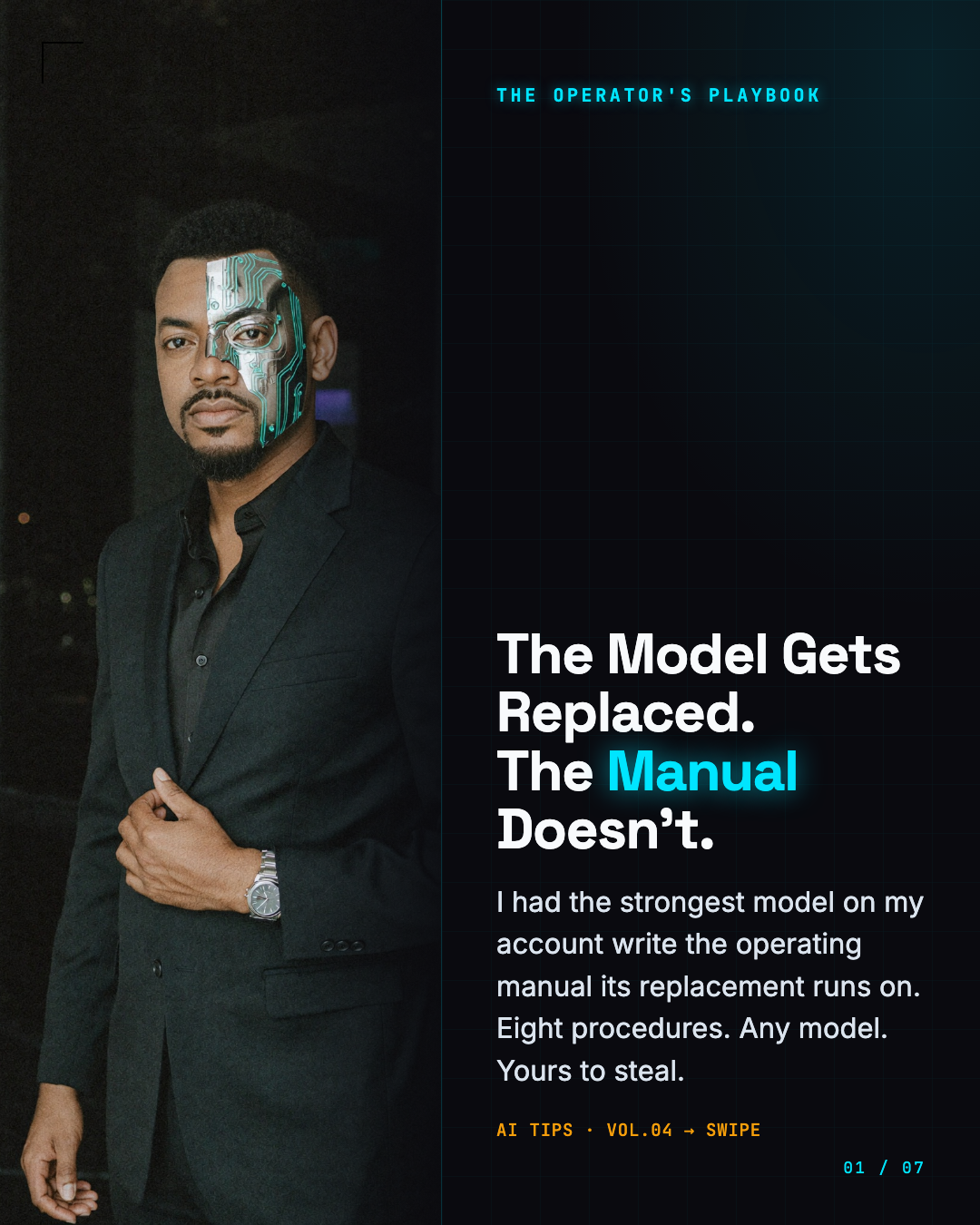
The Model Gets Replaced. The Manual Doesn't.
I had the strongest model on my account write the operating manual its replacement runs on. Eight procedures. Any model. Yours to steal.
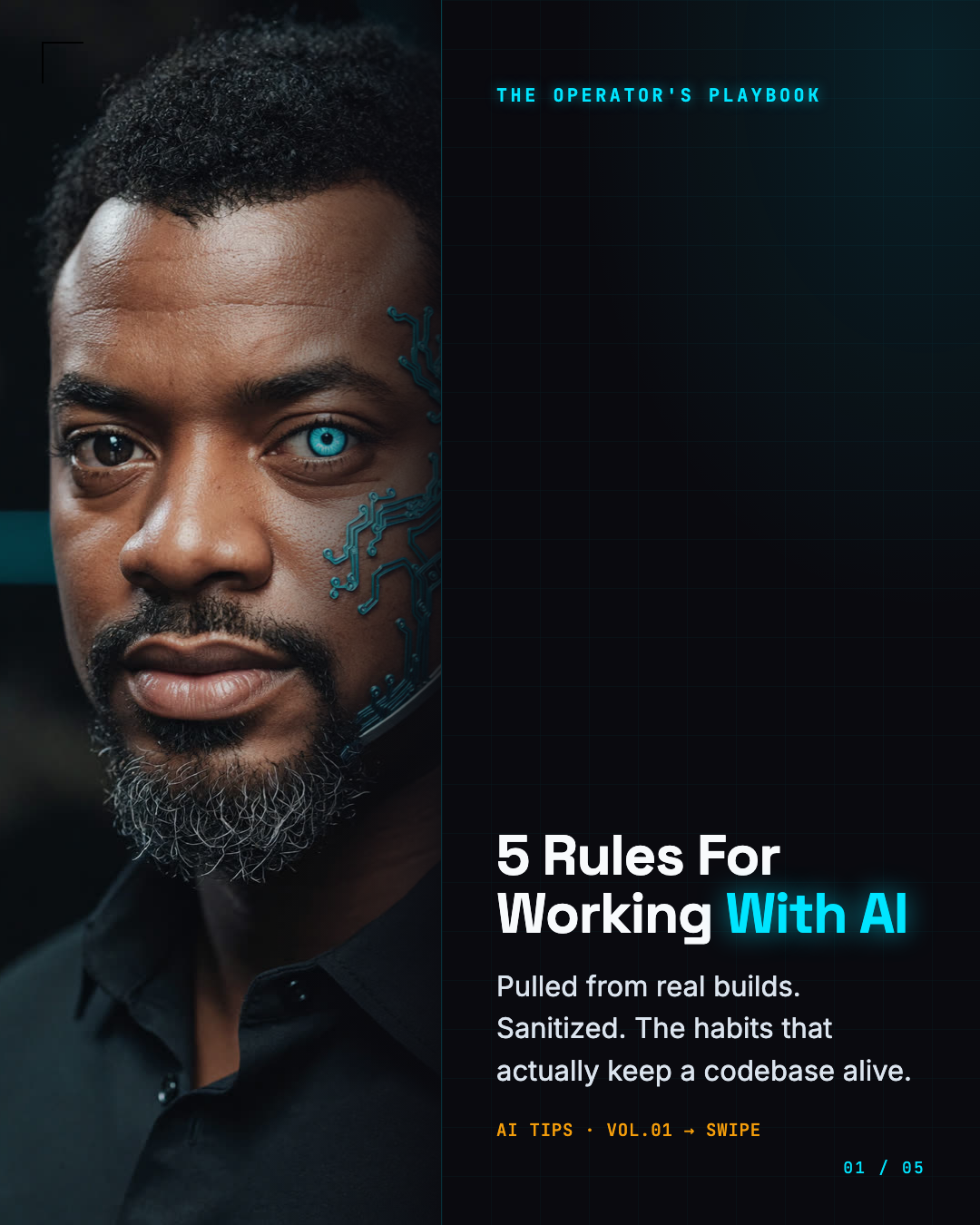
5 Rules For Working With AI (From Real Builds)
Five habits — pulled from real production builds and sanitized — that keep an AI-assisted codebase alive instead of quietly rotting it. The rules behind the graphics.