The Reload Paradox: Why Live Systems Can't Stop to Learn
Most trading systems treat code updates like surgery — stop the patient, operate, restart. That assumption costs more than downtime.

Most trading systems treat code updates like surgery — stop the patient, operate, restart. That assumption costs more than downtime.

We deploy code updates to a 24/7 revenue-generating trading bot without stopping it. Here's the architectural decision that made that possible — and why the obvious solution was wrong.

USDC.e is not USDC. EOA signing is not proxy signing. The wallet you funded is not necessarily the wallet your bot is polling. A developer's guide to the Polymarket integration traps that will cost you a night if you do not know them up front.

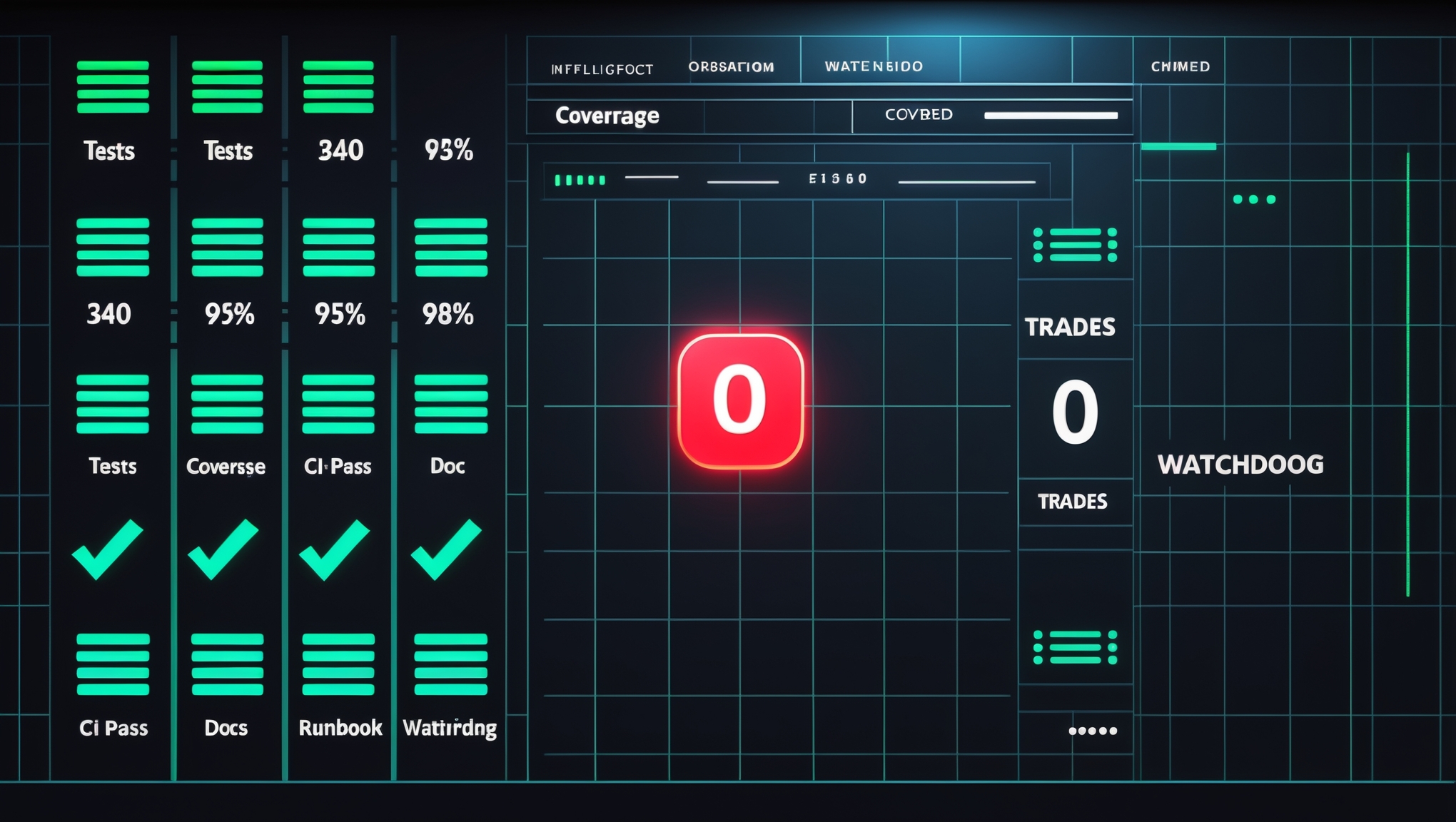
Three hundred and forty tests. Ninety-five percent coverage. Five docs, a runbook, a watchdog, and a launchd plist. In three weeks it had never placed a real trade. This is what we learned when we finally pulled the data instead of writing another fix.

Restarting a live trading bot mid-session isn't a deployment — it's a gamble. Here's how we eliminated that gamble entirely.

Most trading bots treat deployment like a surgery that requires general anesthesia. Foresight doesn't go under anymore. Here's the architecture that made that possible.

Stopping a live trading bot to deploy code is the same as stopping a surgeon mid-operation to sharpen a scalpel. Here's how I built hot reload into an active money-trading system.

The bot was right. The timing was wrong. v4.x had a fundamental reactive architecture problem — by the time signals scored, the CLOB asks were too expensive. v5.0 solved it with event-driven candle boundaries and predictive early-window scoring.

Political prediction markets don't move on charts — they move on information. Hermes is a Python bot that scores political markets using Grok sentiment, Perplexity probability estimation, and calibration consensus from Metaculus and Manifold. Here's how it works.

Sports prediction is a solved problem for the books. It's wide open on Polymarket. Here's how I built Shiva — a 6-factor probability engine that finds edge in NBA and MLB markets using free public APIs and adaptive weights.

Sports prediction markets are inefficient because the crowd prices on narrative, not data. Shiva is an automated bot that estimates true probabilities from team stats, injuries, and media sentiment — then executes when the edge is real.

We built a 666-line candle engine with full TD Sequential integration into PolyEdge v3.0. Four days live, 97 closed trades, 91.3% win rate, and +$694.25 on $1,092 wagered. Here's what predictive signal layers do that reactive TA cannot.

FILTER_5M_DISABLED = False. One line. Should've been the whole story. Instead it kicked off a six-bug root cause chain that exposed every assumption we had about how our trading bot actually found markets — and taught us the most important rule in API integration.

The bot was cycling every 2 minutes — its own watchdog killing it every 129 seconds. The signals inside were perfect: 86–100/100, 92% accuracy, calling direction while the market priced uncertainty at 50/50. One coding session fixed the infrastructure. The rest is on-chain.

Our live Polymarket trading bot was scoring 11 high-conviction signals per day (avg score: 83.3) and blocking every single one. The culprit: a 10-second timing threshold we'd never questioned. Here's what production data taught us about hardcoded constants.

PolyEdge scored 65/100 and sat. Knox traded manually and went 3 for 3. The gap between those two outcomes reveals the exact mechanisms the model was missing.

We spawned a live Polymarket trading session, built a real-time Mission Control dashboard to watch it trade, and within hours the AI agent caught a 4.7% intraday BTC crash with precision. Here's everything — including the loss that taught us the most important rule.