Technical Debt Is Not a Code Problem — It's a Psychology Problem
Technical debt doesn't accumulate because engineers don't know better. It accumulates because human psychology makes future pain feel smaller than present friction.
 ⊕ zoom
Every engineering organization has the same meeting. Someone opens a Jira ticket to address a piece of infrastructure that's been causing pain for eighteen months. The tech lead explains the problem. Everyone agrees it's real. Someone says, "We should prioritize this." And then sprint planning happens, and the debt ticket lands in the backlog again, and the next sprint loads up with features.
This isn't a process failure. It's not a prioritization failure. It's a psychology problem — and until you treat it as one, you will have this meeting forever.
The Cognitive Force Behind Every Deferred Fix
The phenomenon driving this behavior has a name: hyperbolic discounting.
Hyperbolic discounting is the well-documented cognitive bias where humans systematically undervalue future costs relative to present ones — and the discounting is non-linear. Pain that's six months away doesn't just feel half as bad as pain today. It feels almost irrelevant. The further away the consequence, the more dramatically we discount it. This is why "we'll fix it later" is such a persistent and destructive statement in engineering organizations. It's not laziness. It's neuroscience.
The engineer who writes the workaround instead of the clean solution isn't ignorant. They know the workaround is worse. But the pain of the workaround is abstract and future, while the pressure to ship the feature is immediate and concrete. The brain treats these as incomparable — and immediate always wins.
What makes this worse in software is that the consequences of technical debt are genuinely deferred. A bad architectural decision made in Q1 might not cause meaningful pain until Q3 or Q4. By then, the person who made the decision might not even be on the team. The causal link is severed. The cognitive feedback loop that would teach the lesson never fires.
Institutional Psychology Is Real
Here's the deeper cut: organizations develop the same cognitive biases as individuals.
A team that has shipped through technical debt successfully — that has delivered features despite messy infrastructure and hit deadlines despite accumulating shortcuts — develops an organizational status quo bias. The mess becomes normalized. The present state feels like the baseline. Proposing a debt sprint starts to feel like unnecessary disruption, not necessary maintenance.
This is institutional psychology. The organization, as a collective entity, has hyperbolic discounting baked into its culture. Leadership sees a feature backlog that's 40 items deep and can enumerate the business value of each one. The debt items are harder to defend — their value is negative (preventing future pain rather than creating present gain), and the future pain has been discounted to near-zero.
The result is predictable: teams that never systematically address debt until it causes a production incident severe enough to force the conversation. And by then, the cleanup cost is five to ten times what it would have been if addressed incrementally.
What I've Seen at Scale
Managing a 12-engineer team serving 400+ enterprise customers gives you an unambiguous view of debt accumulation dynamics. These are not small teams with limited resources. Enterprise software organizations have planning processes, architecture reviews, and experienced engineers. They still accumulate debt at a rate that surprises everyone.
The pattern I've seen consistently: debt is invisible because it's distributed. No single piece of debt is catastrophic enough to demand immediate attention, so no single piece gets prioritized. But the aggregate is enormous — it lives in slower onboarding times, more complex deployments, more frequent production anomalies, higher cognitive load for every engineer working in the affected systems. The cost is real and ongoing. It just never appears on a single line item.
The fix is making debt visible, named, and owned.
The Three Interventions That Actually Work
1. Name it and track it explicitly. Debt that lives in someone's head doesn't get fixed. Debt that has a ticket, an owner, and a rough cost estimate starts competing for attention on real terms. Create a separate debt backlog. Give items severity ratings based on blast radius, not just inconvenience. Review it in sprint planning, not just quarterly.
2. Time-box debt sprints. The reason debt never gets addressed is that it has to compete with features in every sprint — and it loses, because features have cleaner business justifications. Remove the competition. Reserve a fixed percentage of sprint capacity for debt, non-negotiable. At one of my past orgs, we implemented explicit debt sprints on a rotation — dedicated cycles where the team's entire focus is cleanup, refactoring, and hardening. The business case is simple: you're buying down the compound interest on your debt before it becomes unpayable.
3. Debt-to-feature ratios in sprint planning. Make the tradeoff visible at the planning level. If you're running at a debt-to-feature ratio of 5:95, leadership can see that and make an informed decision. Most of the time, organizations don't track this at all — they add features and assume debt is being addressed "as we go," which is never actually true.
"We'll clean it up later" is hyperbolic discounting in its purest form. The moment you hear it in a planning meeting, call it by name. Not to shame the person who said it — to make the cognitive bias visible so the team can decide consciously rather than drift unconsciously into the pattern.
The Meta-Problem
The deepest version of this problem is that debt-averse engineering cultures require a leader willing to make present sacrifice for future health — and that leader has to fight the same cognitive biases their team has, plus the pressure from above to ship visible value.
Addressing technical debt requires what psychologists call temporal self-regulation: the ability to act against your immediate reward signal in service of long-term outcomes. It's the same cognitive capacity required for compound investing, physical training, and strategic thinking. It doesn't come naturally. It has to be institutionalized.
Build the processes that force the discipline. Make debt visible. Time-box the sprints. Track the ratio. Not because engineers are lazy or ignorant — but because you're fighting human psychology, and you need structural defenses against it.
The code is fixable. The bias requires architecture.
The engineering patterns in this article are covered in the AI Infrastructure track — persistent platforms that run themselves. 11 lessons.
Start the AI Infrastructure track →Explore the Invictus Labs Ecosystem
Follow the Signal
If this was useful, follow along. Daily intelligence across AI, crypto, and strategy — before the mainstream catches on.
The Bot That Had Never Made a Dollar
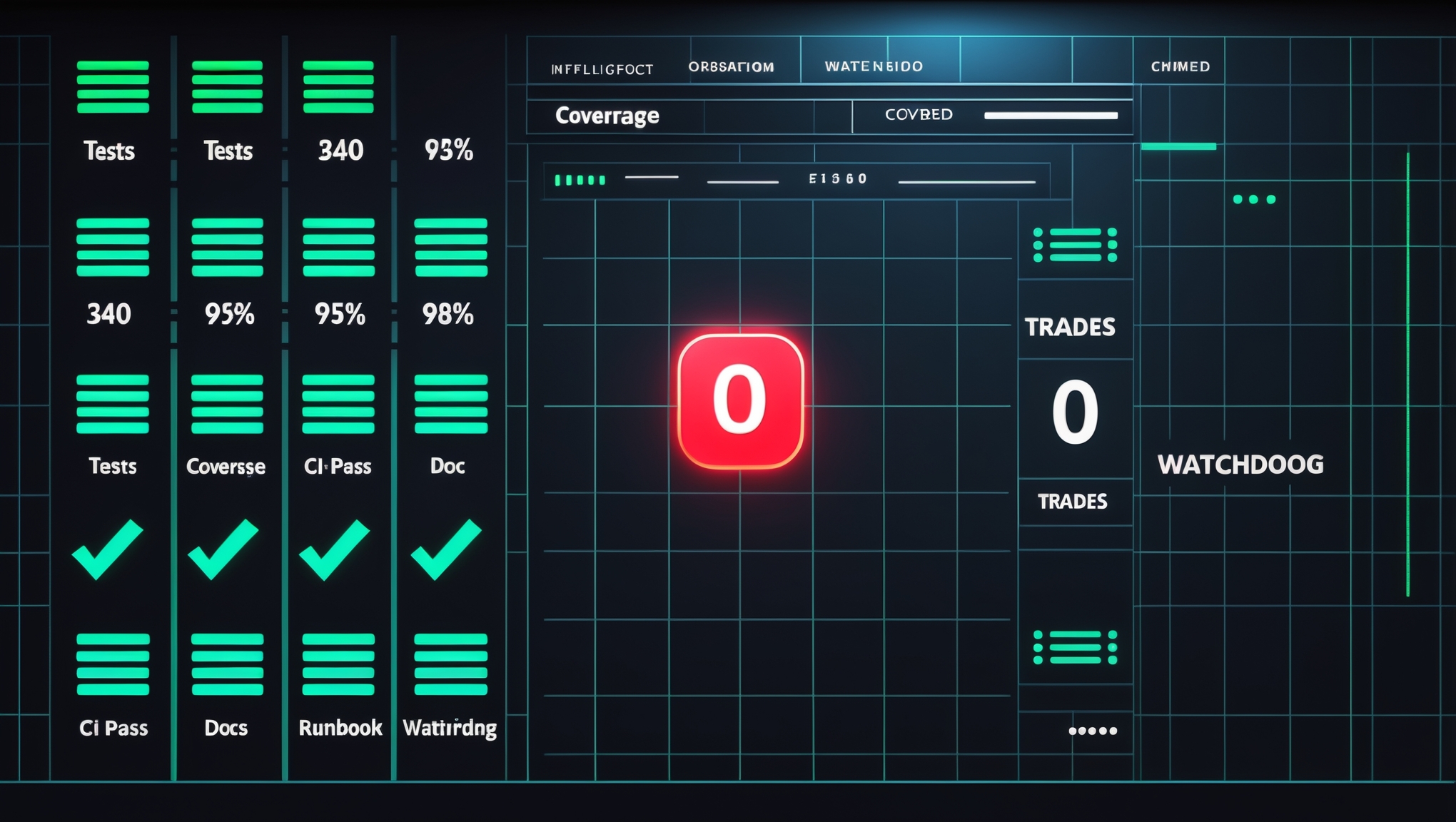
Three hundred and forty tests. Ninety-five percent coverage. Five docs, a runbook, a watchdog, and a launchd plist. In three weeks it had never placed a real trade. This is what we learned when we finally pulled the data instead of writing another fix.

Why I Built Blueprint: The Framework I Wish I Had
After 16 years of building products, leading teams, and watching smart people ship the wrong thing confidently, I built the AI tool I always needed. This is why Blueprint exists.

Building an Agent Operations Platform in One Session
One YouTube video, one insight, one session. What started as a note about persistent agent expertise turned into a full agent operations platform: 22 specialist roles, behavioral health monitoring, directive lifecycle tracking, and an E2E proof that closed in 8 minutes.