48 Skills, One Agent, Zero Focus: Building the Egyptian Pantheon AI Team
One AI agent running 48 skills is the same anti-pattern as one engineer doing everything. I split it into 10 specialized agents — named after Egyptian gods — with zero breaking changes to existing infrastructure.
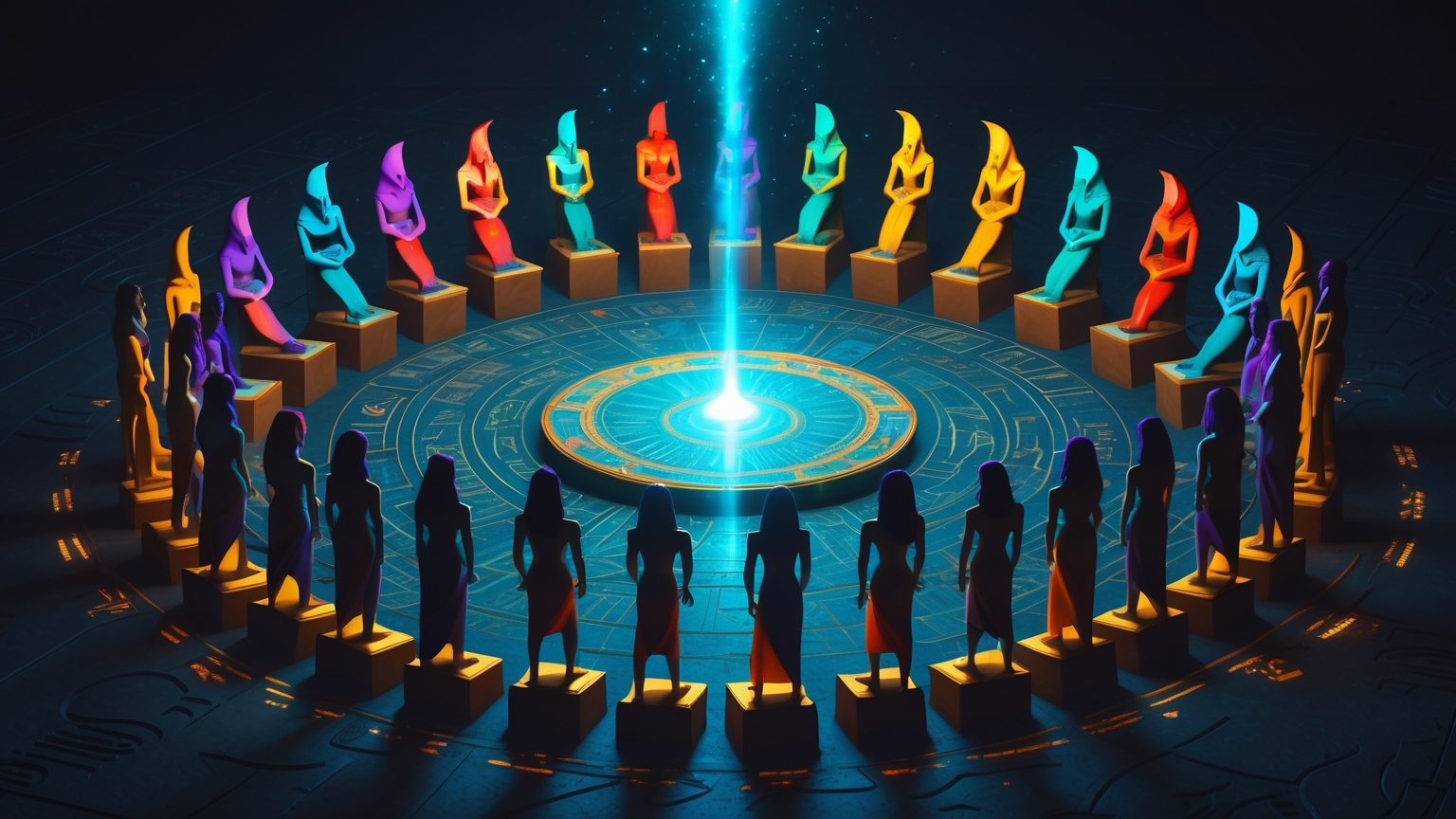
Imagine a single engineer responsible for sales, security, content creation, infrastructure, market analysis, social media, monitoring, and executive reporting — simultaneously. No sane engineering manager would design a team this way. And yet, that's exactly how most AI agent systems are built.
OpenClaw, the AI agent platform I run 24/7 on a Mac Mini, had grown to 48 skills and 40 automated cron jobs — all funneled through one mega-agent. Every task got the same undifferentiated context. A security audit got the same "personality" as a blog post. A trading signal got the same priority framing as a Discord notification. The agent wasn't getting smarter with each new skill. It was getting diluted.
So I did what any engineering leader would do: I reorganized.
The Mega-Agent Trap
The mega-agent anti-pattern is seductive. One agent, one system prompt, one context window — simple to reason about, easy to deploy. But it breaks down at scale for the same reason a one-person team breaks down: context switching destroys quality.
When you give an LLM 48 tools and no domain framing, it has to infer intent from scratch every time. A security scan and a poetry generation both start from the same blank slate. There's no accumulated expertise, no domain-specific heuristics, no sense of ownership.
Research backs this up. Narrowly-scoped agents with 5-10 tools consistently outperform generalist agents on domain-specific tasks. The cognitive overhead of tool selection alone degrades performance as the tool count climbs. It's the same principle behind microservices: bounded contexts produce better outcomes than monoliths — if you get the boundaries right.
The Egyptian Pantheon
I needed a naming convention that was memorable, thematic, and scalable. Egyptian mythology gave me exactly that — a pantheon of deities, each with a clear domain, each with distinct personality traits that map naturally to agent personas.
Each agent gets:
- A domain — 3-7 skills, tightly scoped. Maat handles trading and market analysis. Sekhmet handles security and threat response. Ptah handles content creation.
- KPIs — measurable outcomes tied to the domain. Tesseract Intelligence competitive scans (Isis) are measured on freshness and accuracy. InDecision Framework trading signals (Maat) are measured on conviction score and edge detection.
- An Akashic namespace — every agent writes to a dedicated namespace in the Akashic Records memory system. Sekhmet's security findings don't pollute Ptah's content drafts. Each agent builds its own institutional knowledge over time.
The mapping isn't arbitrary. Ra (the sun god) orchestrates — he's the one who dispatches and coordinates. Thoth (god of knowledge and writing) manages documentation and the knowledge base. Anubis (guardian of the underworld) monitors health and staleness — he watches for things that are dying. The mythology provides intuitive mnemonics for what would otherwise be dry role labels.
Persona Injection — Zero Breaking Changes
Here's the constraint that made this interesting: I had 40 live cron jobs in production. Some had been running stable for months. I wasn't going to rewrite the task payloads, restructure the cron system, or introduce a new dispatch layer. The migration had to be invisible to existing infrastructure.
The solution: persona injection. A thin engine that sits between the cron scheduler and the agent, prepending an identity block to the existing payload.
The identity block contains:
- Who you are — agent name, domain, personality traits
- What you own — the skills in your domain
- How you're measured — KPIs and quality standards
- Where you write — Akashic Records namespace
- POST-TASK instruction — what to do after the main task completes (journal entry, metric update, etc.)
The original task payload passes through unchanged. The cron doesn't know or care that it's now being handled by "Isis" instead of the undifferentiated mega-agent. If anything goes wrong, rollback is trivial: strip the prepended block. The underlying infrastructure never changed.
This is the same pattern behind middleware in web frameworks — intercept, enrich, pass through. No breaking changes. No migration. Just a richer context for every execution.
The Proof
Theory is nice. Let me show you what happened when I turned it on.
Sekhmet's first journal entry:
The security agent ran her nightly audit and, without any special prompting beyond the persona injection, wrote a structured journal entry to the Akashic Records under namespace sekhmet. The entry included threat classifications, scan results, and a self-assessment against her KPIs. She owned the output in a way the mega-agent never did.
Ra's dead zone scan:
Ra, the orchestrator, ran his morning health check and reported in his own voice — identifying cron jobs that hadn't fired in 48 hours, flagging them as "dead zones," and recommending remediation. The POST-TASK instruction triggered a journal entry summarizing what he found, written with the authority of someone who owns system health.
The POST-TASK pattern worked:
This was the key validation. Each agent, after completing their primary task, executed a follow-up action — writing a journal entry, updating a metric, or filing a finding. The mega-agent never did this because it had no concept of "after I'm done with my job." The persona injection gave each agent a sense of completion and accountability.
25 crons migrated in the first pass. Zero regressions. Every existing task continued to produce the same outputs, but now with richer context, better attribution, and a memory trail in the Akashic Records.
What Comes Next
The pantheon is live, but the real leverage comes from what it enables:
KPI dashboards — each agent's namespace in Akashic Records becomes a performance ledger. Track Maat's trading signal accuracy over time. Measure Isis's intelligence freshness. See which agents are carrying their weight and which need tuning.
Cross-agent memory — Isis discovers a competitor move. Maat sees market impact. Ptah writes the analysis. Today these are separate cron runs. Tomorrow, Akashic Records becomes the coordination bus — one agent's output triggers another agent's input.
Thoth digests — the knowledge god synthesizes what the entire pantheon learned each day into a single briefing. Not a log dump. A narrative — "Here's what your agents discovered, decided, and delivered today."
The mega-agent was a monolith pretending to be a team. The pantheon is a team that shares a memory. That's the difference between adding skills and adding capability.
Explore the Invictus Labs Ecosystem
Follow the Signal
If this was useful, follow along. Daily intelligence across AI, crypto, and strategy — before the mainstream catches on.

Foresight v5.0: How I Rebuilt a Prediction Market Bot Around Candle Boundaries
The bot was right. The timing was wrong. v4.x had a fundamental reactive architecture problem — by the time signals scored, the CLOB asks were too expensive. v5.0 solved it with event-driven candle boundaries and predictive early-window scoring.

Hermes: A Political Oracle That Bets on Polymarket Using AI News Intelligence
Political prediction markets don't move on charts — they move on information. Hermes is a Python bot that scores political markets using Grok sentiment, Perplexity probability estimation, and calibration consensus from Metaculus and Manifold. Here's how it works.

Leverage: Porting the Foresight Signal Stack to Crypto Perpetuals
The signal stack I built for prediction markets turns out to work on perpetual futures — with modifications. Here's how a 9-factor scoring engine, conviction-scaled leverage, and six independent risk gates become a perps trading system.