Boyd's OODA Loop Is Not a Combat Framework — It's a Framework for Life
Colonel John Boyd designed the OODA loop for aerial dogfights. But the insight that Orient is the most important phase — and that Orient contains all your biases — makes this the most powerful cognitive framework for traders, engineers, and leaders.
 ⊕ zoom
Whoever can handle the quickest rate of change survives.
— Colonel John Boyd · USAF
Colonel John Boyd was arguably the most important military theorist of the 20th century that most people have never heard of. Fighter pilot, Pentagon reformer, architect of the maneuver warfare doctrine that drove the 100-hour ground campaign in Gulf War I. The man flew 22 dogfights as an instructor and never lost one.
He designed the OODA loop for aerial combat — the kill-or-be-killed, 3G environment of supersonic dogfighting where decision latency gets you killed. But what Boyd built is not a combat framework. It's a universal model of how intelligent agents navigate high-speed, high-uncertainty environments.
Which describes trading. Engineering sprints. Organizational change. Markets. Basically everything worth doing at the elite level.
The Loop You Think You Know
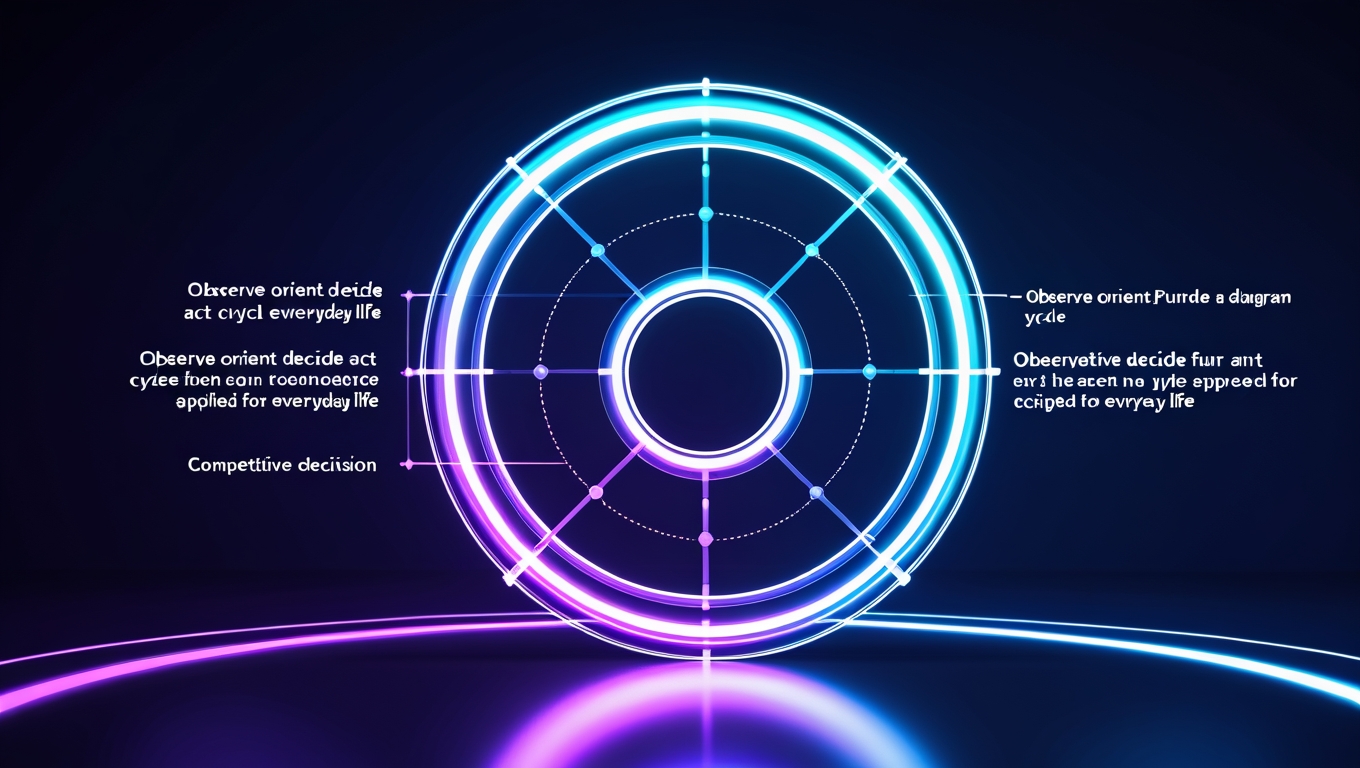
Most people who've encountered OODA describe it as: Observe what's happening. Orient yourself. Decide what to do. Act. Repeat. They treat it as a cycle — like a faster version of a decision checklist.
That framing misses the entire point.
Boyd didn't build a sequential checklist. He built a model of cognitive architecture. And the key to understanding it is recognizing that the four phases are not equal. One phase dominates all the others.
Boyd's Core Insight: The Orient phase is not just a step in the loop — it IS the loop. Orient contains your mental models, cultural traditions, genetic heritage, prior experience, and ability to analyze and synthesize new information. Everything you observe gets filtered through Orient before it influences a decision. If your Orient is corrupted, the entire loop produces corrupted output — no matter how good your observations are.
Orient Is Where Bias Lives
Think about what Orient actually contains. It's not neutral processing. It contains:
- Every cognitive bias you've accumulated (confirmation bias, anchoring, availability heuristic, loss aversion)
- Every mental model you've built — accurate and inaccurate
- Your cultural and institutional conditioning
- Your previous experience — which can be a guide or a trap
- Your analytical frameworks and the gaps in them
When you observe a market setup, the raw data goes into Orient before it produces a decision. If your Orient says "this pattern means continuation" based on previous experience, but the context has changed in a way your Orient hasn't been updated to recognize — you make a bad trade. The observation was accurate. The decision loop was corrupted at the Orient phase.
This is why two analysts can look at identical data and reach opposite conclusions. They're not using different data. They're running it through different Orients.
Inside the Loop: The Real Competitive Edge
Boyd's original combat application was elegant: if you can complete your OODA loop faster than your adversary completes theirs, your actions become inputs to their Observe phase before they've finished processing your previous action. You're setting the tempo. They're reacting to a reality that's already changed. They're perpetually one step behind.
This applies directly to every competitive domain:
In trading: Markets move on information. If your Observe-Orient-Decide-Act cycle on new information is faster and more accurate than consensus, you act before consensus catches up. Alpha is the gap between your loop speed and the market's loop speed. This is why systematic, data-driven frameworks outperform — they reduce the latency introduced by a slow, biased manual Orient phase.
In engineering: Sprint teams that have clear, shared mental models (a well-built collective Orient) move faster through ambiguous requirements because they spend less time in orientation debates. Technical debt is often an Orient corruption problem — the team's mental model of the system diverges from the system's actual state.
In leadership: Organizations that are slow to adapt aren't slow because they lack information. They're slow because their organizational Orient — their culture, their embedded assumptions, their institutional memory — creates friction between observation and action. Organizational change is literally Orient rewiring.
The InDecision Framework as OODA Implementation
When I built the InDecision Framework for crypto market analysis, I wasn't consciously designing an OODA system. But that's what it is.
The six-factor model — Daily Pattern, Volume, Timeframe Alignment, Technical Confluence, Market Timing, Risk Context — is a systematic Orient construction process. Instead of running raw price action through a biased, experience-dependent human Orient, you run it through a calibrated, weighted framework that applies consistent logic across every setup.
The accuracy gain isn't from better data. It's from a less corrupted Orient. The framework forces discipline at the orientation phase — which is exactly where undisciplined traders blow up their loops.
How to Rewire Your Orient
If Orient is where bias lives, then cognitive development — the Rewired Minds thesis — is literally Orient improvement. It's not self-help. It's a technical upgrade to your decision-making hardware.
Practical Orient upgrades:
Adversarial red-teaming. Before acting on a high-conviction position, spend 5 minutes actively constructing the strongest possible case against it. You're forcing your Orient to process the counterfactual instead of suppressing it.
Pre-mortem analysis. Project forward to a failure state and ask what caused it. This surfaces Orient-level assumptions that you're currently treating as facts.
Calibrated journaling. Track your decisions and their outcomes with explicit hypothesis statements. Over time, you build a map of where your Orient is accurate and where it's systematically wrong. Fix the systematic wrong patterns.
Framework discipline over gut discipline. Gut instinct is unreviewed Orient output. Frameworks are Orient architecture you can audit and improve. Use both, but know which is which.
Boyd spent his career trying to help institutions and individuals move faster and think clearer in the fog of uncertainty. The OODA loop is his gift — a precise diagnosis of where decisions break down and a roadmap for fixing it.
The framework is there. Most people never get past the surface definition.
Go deeper.
The trading intelligence methodology behind this is taught in the Competitive Intelligence track. 8 lessons.
Start the Competitive Intelligence track →Explore the Invictus Labs Ecosystem
Follow the Signal
If this was useful, follow along. Daily intelligence across AI, crypto, and strategy — before the mainstream catches on.

CJNG's Center of Gravity Just Fell. Here's Why That Makes Mexico More Dangerous.
Killing the most wanted cartel kingpin in the world sounds like a victory. Clausewitz would say: it depends on whether he was actually the center of gravity — or just the most visible node.

Iran's A2/AD Play: Why the Strait of Hormuz Just Got More Complicated
Whether or not Iran's new naval missile is actually hypersonic is the wrong question. The right question is what a 90-mile sea-based SAM bubble does to the strategic calculus for US carrier operations in the Persian Gulf.

Ukraine's Robot Army and the Death of Attrition Warfare
In July 2025, Ukraine captured Russian soldiers using an assault force made entirely of drones and robots. The future of land warfare isn't theoretical anymore — it's operational. The strategic implications for everything from conscription to defense economics haven't been absorbed yet.