AI’s Bottleneck Isn’t Chips. It’s Water.
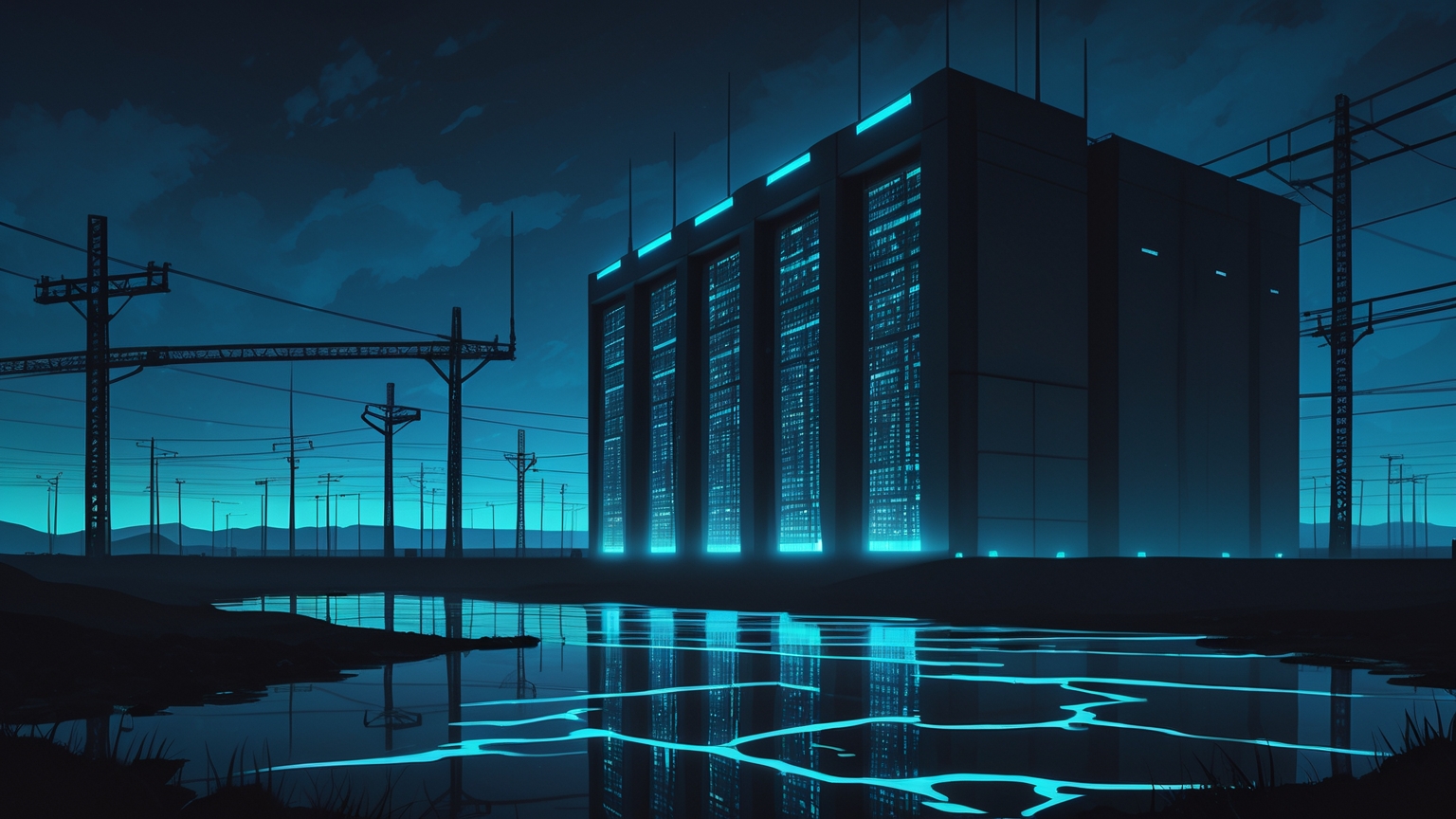
The AI race looks like a compute contest because compute is visible. The real constraint sits under the floorboards: water, and the systems that keep thermal failure from ending your uptime.
 ⊕ zoom
Everyone talks about AI as if the scarce input is intelligence. It is not. The scarce input is cooling.
We framed the last two years as a silicon arms race, so most teams optimized for model quality, inference latency, and GPU access. Those matter. None of them matter when the physical plant behind your stack cannot reject heat fast enough to keep systems stable.
This is the strategic mistake: we keep planning AI roadmaps in software quarters while the enabling infrastructure moves in utility timelines. Product teams iterate in weeks. Grid and water resilience programs move in years. If you lead engineering and you do not include water exposure in your architecture decisions, you are building velocity on top of a hidden single point of failure.
The core insight is simple: AI performance scales with compute density, compute density scales thermal load, and thermal load binds to water systems in far more places than most software organizations admit. That coupling is the new infrastructure asymmetry between teams that can ship reliably and teams that cannot.
Compute Density Turns Environmental Stress Into Product Risk
AI workloads changed the thermal profile of modern infrastructure. Traditional enterprise traffic is spiky and mixed. AI inference and training patterns are different: sustained, high-density, and less forgiving under thermal throttling. The hotter your racks run, the more your uptime depends on cooling continuity.
That continuity is often discussed as an energy problem. It is also a water problem. Evaporative and hybrid cooling systems are common because they remain efficient in many environments. Even closed-loop systems still depend on broader water and temperature conditions around facilities. Once regional stress rises, cooling economics and reliability degrade together.
When you hear water stress values far above 100%, do not treat that as environmental trivia. Treat it as an SRE signal. It means the operating context is consuming water faster than natural replenishment supports. That does not guarantee immediate outages, but it does indicate structural fragility. Fragility is what turns routine demand spikes into incident tickets.
Engineering leaders are comfortable with dependency graphs in code. Apply the same logic to infrastructure dependencies. If your growth plan assumes uninterrupted inference capacity in a region with chronic water stress, your architecture has an undeclared risk budget.
AI reliability is now constrained by physical systems your software dashboards do not show by default. If you only monitor model latency and token throughput, you are measuring performance after infrastructure risk has already materialized.
The New Build-vs-Buy Question Is Geographic, Not Just Financial
Most AI platform discussions reduce build-vs-buy to cost, speed, and control. That framing is incomplete. You also need to ask where your vendor’s capacity actually sits and what environmental regime it depends on.
Two providers can offer identical model quality and similar price curves while carrying very different physical risk. One may be anchored in regions with lower baseline stress and diversified cooling strategy. The other may be concentrated in high-stress zones where utility disruptions or policy restrictions create operational volatility. If your team does not evaluate that distinction, you are not doing architecture review. You are doing feature shopping.
For engineering managers running enterprise workloads, this has direct implications:
- Capacity planning must include geographic diversity assumptions, not just instance quotas.
- Resilience design must include provider concentration risk tied to environmental constraints.
- Procurement conversations must include cooling and water strategy disclosures as first-class criteria.
The contrarian point: teams obsessed with model benchmark deltas may lose to teams with inferior models but superior infrastructure positioning. In operational terms, a slightly weaker model with higher reliability often beats a stronger model that fails under stress windows.
That is not theory. It is standard systems doctrine. In any competitive environment, you win less by maximizing peak capability and more by protecting your operational continuity.
Why This Looks Like a Software Problem Too Late
Physical constraints stay invisible until they hit delivery timelines. By then, the failure mode is usually misdiagnosed.
A product org sees delayed launches, unpredictable latency, or vendor-side throttling and assumes the issue is demand forecasting or model serving inefficiency. Sometimes that is true. Sometimes the issue is that infrastructure providers are reallocating constrained cooling capacity, repricing stressed regions, or enforcing policy adjustments tied to utility realities.
From the software side, those look like random externalities. They are not random. They are second-order effects of siting and resource exposure.
This matters for a team of 12 engineers as much as for a hyperscaler. Mid-sized teams cannot brute-force around persistent volatility. Every unplanned platform disruption steals cycle time from roadmap execution, burns trust with stakeholders, and shifts engineers from value creation to incident response.
The right response is to move these constraints upstream in your decision process:
- During architecture reviews: include “environmental dependency exposure” as a required section.
- During vendor evaluation: request public sustainability and cooling disclosures, then map them to your uptime requirements.
- During quarterly planning: reserve buffer for platform migration or multi-region failover, even if current performance looks stable.
This is where a lot of AI programs break. Leadership funds model experimentation but underfunds infrastructure optionality. Then a single external shock forces reactive rewrites. You can avoid that by treating physical dependencies as design inputs, not postmortem topics.
What This Means for AI Strategy Over the Next 24 Months
The winning organizations will separate into two camps: those that treat AI as a software layer, and those that treat AI as a full-stack operating system spanning software, facilities, utilities, and geopolitics.
If you want durable advantage, execute four moves now.
1) Add infrastructure realism to AI roadmap governance. Your AI steering group should review not only model performance and feature adoption, but also provider concentration, geographic exposure, and continuity assumptions. Make that review recurring, not ad hoc.
2) Design for portability before you need it. Abstracting every model call is not always practical, but you can still isolate core workflows so migration cost stays finite. Portability is not vendor hostility. It is risk control.
3) Treat “stable enough today” as a temporary state. Environmental and geopolitical pressure compounds. Regions with high stress do not usually become less constrained without major investment cycles. Assume volatility increases, then build accordingly.
4) Educate executives on physical bottlenecks in plain business language. Do not brief this as climate commentary. Brief it as margin, uptime, and delivery risk. Leaders allocate resources when they see direct linkage to revenue and customer trust.
The next AI moat is not who can access the smartest model. It is who can sustain high-quality AI delivery when shared infrastructure enters stress conditions.
This is the same principle that shows up in military doctrine and market systems: contested environments punish brittle optimization. They reward adaptable structures with reserve capacity.
In AI, that means the technical edge is no longer just prompt engineering, fine-tuning, or agent orchestration. The edge is constraint-aware architecture—building systems that keep shipping when dependencies get noisy, scarce, or politically contested.
Most teams will learn this during disruption. You can learn it by design.
Explore the Invictus Labs Ecosystem
Follow the Signal
If this was useful, follow along. Daily intelligence across AI, crypto, and strategy — before the mainstream catches on.

What Your Glasses See, They Own: The Ambient Data Problem in AI Wearables
AI wearables don't collect data the way your phone does — they collect ambient reality. The trust architecture that governs that data was never designed for what these devices actually capture.
Claude Code Remote Control: The End of Being Tethered to Your Desk
Anthropic just shipped mobile remote control for Claude Code. No SSH hacks. No cloud merges. Your phone becomes a window into your local dev environment — and it changes the builder workflow entirely.

Perplexity Computer and the Fork in the AI Agent Road
Perplexity just launched a managed multi-model agent platform that orchestrates 19 AI models. It is a direct shot at open-source agent systems — and the architectural trade-offs tell you everything about where this industry is splitting.