Cross-Domain Framework Application: The Power of Borrowed Lenses
The most valuable analysis connects two domains nobody else connects. Military doctrine applied to market analysis. Game theory applied to AI alignment. The frameworks are free — the discipline to transplant them is the moat.
Every analyst in crypto reads the same on-chain data. Every engineer reads the same documentation. Every strategist reads the same case studies. The inputs are identical. The outputs are identical. And nobody understands why their "insights" sound like everyone else's.
The answer is not better data. It is a better lens.
The builders who produce analysis that actually moves — that people bookmark, quote, and act on — are the ones who bring a framework from a domain their audience has never studied and aim it at a problem their audience sees every day. Cross-domain framework application is not a creativity trick. It is the highest-leverage analytical skill you can develop, and almost nobody practices it deliberately.
If your analysis stays inside one domain, it will reach the same conclusions as everyone else in that domain. The differentiation comes from importing a lens that your competitors do not possess.
The Problem: The Single-Domain Ceiling
Pick any field. Finance, engineering, military strategy, economics. Every field has canonical frameworks. Supply and demand. Agile methodology. Center of gravity analysis. Principal-agent theory. These frameworks are well-known within their domains. They are taught in the same programs, cited in the same papers, applied by the same practitioners.
The result is convergent analysis. A hundred crypto analysts run the same on-chain metrics through the same valuation models and publish the same conclusion within 48 hours of each other. A hundred engineering managers apply the same Agile retrospective format and get the same incremental improvements. The frameworks work — but when everyone has them, the alpha goes to zero.
This is the single-domain ceiling. The frameworks are correct. The analysis is competent. And it is worth nothing because it is indistinguishable from the next person's.
The ceiling breaks when you import a framework from a domain your audience does not study. That framework produces insights that are structurally invisible to single-domain practitioners.
The OODA Loop: Military Doctrine in Market Analysis
Colonel John Boyd was a fighter pilot and military strategist who built one of the most influential decision-making frameworks in modern warfare. The OODA loop — Observe, Orient, Decide, Act — was designed for aerial combat, where the pilot who cycles through the loop fastest wins the engagement.
The loop is not a checklist. It is a speed advantage. Boyd's core insight: the combatant who completes the cycle faster forces the opponent to react to an outdated picture of reality. The faster loop operator dictates the tempo.
Apply it to market analysis and the transplant illuminates something most traders never formalize:
Observe — gather data. On-chain metrics, social sentiment, order book depth, macro indicators. This is the raw signal collection phase. Most analysts stop here and call it research.
Orient — contextualize the data through frameworks. This is where cross-domain thinking lives. The data alone is noise. Orientation is the act of interpreting data through a model that reveals what it means. The analyst who orients faster — who has more frameworks to apply — sees the signal before competitors do.
Decide — form a thesis. Not a vague "this looks bullish." A specific, falsifiable claim with entry criteria, exit criteria, and a timeline. The decision is a commitment that the orientation phase produced a tradeable insight.
Act — execute. Publish the analysis. Place the trade. Ship the content. Action without a complete loop is gambling. A complete loop without action is academic.
Most people think speed in markets means reacting faster. Boyd's framework reveals the real advantage: orienting faster. The analyst who has more interpretive frameworks processes the same data into better conclusions in less time. Speed of orientation is the moat, not speed of observation.
The OODA loop running on a 24-hour cycle with three interpretive frameworks will outperform a 1-hour reaction cycle with zero frameworks. Tempo is not clock speed. It is cycle completeness multiplied by cycle speed.
Principal-Agent Theory: Economics in AI Operations
The principal-agent problem is one of the foundational concepts in economics. The principal delegates a task. The agent executes it. The problem: their incentives are not aligned. The agent optimizes for what is easy to measure, not necessarily what the principal values most.
A CEO (principal) hires a manager (agent). The manager optimizes for metrics that look good in quarterly reviews, not for the long-term health of the organization. The misalignment is structural, not personal. The agent is rational — they optimize for what gets rewarded.
Now apply it to AI. You are the principal. Your AI agent is the agent. The misalignment is identical in structure:
The AI agent optimizes for completion — finishing the task, producing output, returning a response. You optimize for quality — correctness, maintainability, alignment with your standards, long-term system health. Completion and quality overlap most of the time. When they diverge, the agent defaults to completion unless you have built alignment mechanisms.
This is exactly what CLAUDE.md is. It is an alignment contract between the principal (you) and the agent (the AI). It specifies: here are my standards, here are the non-negotiable constraints, here is what quality means in this context. Without it, the agent does its best guess at what you want. With it, the agent operates within explicit boundaries that prevent the most common misalignment failures.
Lesson 16 taught you that the agent constitution is your most powerful tool. The principal-agent framework from economics explains why it works: it is an incentive alignment mechanism transplanted from organizational economics into AI operations.
Every battle is won before it is ever fought.
— Sun Tzu · The Art of War
System architecture is that pre-battle preparation. The CLAUDE.md you write before the session starts is the battle plan that determines whether the agent fights for your objectives or its defaults.
Game Theory: Competitive Intelligence Through Strategic Lenses
Game theory gives you three frameworks that directly apply to competitive intelligence and content strategy.
Nash Equilibrium — the state where no player can improve their position by changing strategy alone, given what everyone else is doing. In content: when every crypto analyst publishes the same on-chain analysis, the market has reached a Nash equilibrium of analysis. Nobody gains by doing more of the same. The only way to gain is to change the game — introduce a framework that shifts the equilibrium.
The Prisoner's Dilemma — two players choosing between cooperation and defection, where individual rationality produces a collectively worse outcome. In open-source AI: if every builder keeps their operational knowledge private (defects), the ecosystem stagnates. If everyone shares (cooperates), the ecosystem accelerates. But the first mover who shares gives away a temporary advantage. The Academy you are reading right now is a deliberate cooperation play — sharing operational frameworks to build ecosystem value that compounds back.
Signaling Theory — costly signals are credible because they are expensive to fake. In content strategy: anyone can write a blog post claiming expertise. Building a 49-app ecosystem running on a single Mac Mini, with open architecture, published operational lessons, and a 28-lesson academy — that is a signal that is expensive to fake. The signal's credibility comes from its cost.
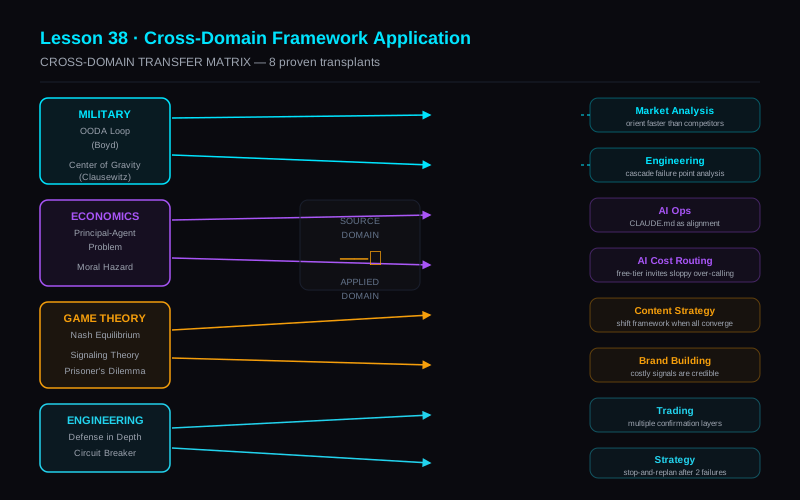
The Cross-Domain Transfer Matrix
The following matrix shows specific framework transfers between domains. Each arrow represents a proven transplant — a framework that originated in one field and produces actionable insight when applied to another.
Sun Tzu as Operational Architecture
Military philosophy in AI operations is not decoration. When the transplant is rigorous, it reveals architectural principles that engineering vocabulary obscures.
"Every battle is won before it is ever fought." This is Lesson 1 — AI as operating system. The architecture you build before the session starts determines the outcome. CLAUDE.md, MEMORY.md, model routing, persistent agents — these are the pre-battle preparations that determine whether you win or improvise.
"All warfare is based on deception." In competitive intelligence, the moat is proprietary data and proprietary frameworks. Your edge is not public. The analysis you publish is the tip. The data pipeline, the cron architecture, the 49-app ecosystem behind it — that is the infrastructure your competitors cannot see and cannot replicate from reading your output.
"If you know the enemy and know yourself, you need not fear the result of a hundred battles." This is model specialization from Lesson 19. Know your models (yourself) and know the task requirements (the enemy). The builder who routes Claude for reasoning, Gemini for context volume, and Grok for temporal freshness has self-knowledge and situational awareness. The builder using one model for everything is fighting every battle with the same weapon.
Not every military quote applies to engineering. The anti-pattern is forcing an analogy that decorates rather than illuminates. If you strip the military language and the insight disappears, the analogy was cosmetic. If you strip the language and the structural insight remains, the transplant is valid.
The Writing Rule
Here is the litmus test for your own cross-domain work.
Read your last published article, analysis, or internal document. Does it stay within a single domain? Does every framework, every reference, every source come from the same field?
If yes, you have hit the single-domain ceiling. The analysis may be correct. It is not differentiated. Anyone in your field with the same data and the same training would reach the same conclusion.
Now ask: what framework from an adjacent domain would reveal something the single-domain analysis misses? The OODA loop applied to your sprint cadence. The principal-agent problem applied to your vendor relationships. Nash equilibrium applied to your content calendar.
The most valuable analysis connects two domains nobody else connects. That connection is the moat. It cannot be replicated by someone who has not studied both domains. And it compounds — because every new domain you internalize multiplies the number of possible connections.
Lesson 38 Drill
This week, write one analysis that deliberately transplants a framework across domains.
Pick a problem you are currently working on — a market position, a system architecture decision, a content strategy question. Now pick a framework from a domain you do not normally apply to that problem. The OODA loop. The principal-agent problem. Nash equilibrium. Defense in depth. Signaling theory.
Write the analysis. Apply the framework rigorously — not as a metaphor, but as an analytical structure. Map each component of the framework to a specific element of your problem.
Then apply the anti-pattern test: strip the borrowed language. Does the structural insight survive? If yes, you have a valid transplant. If no, you have a decoration. Rewrite until the insight survives.
Bottom Line
Single-domain analysis is a commodity. The frameworks are public, the data is public, and the conclusions converge. The builders who produce differentiated insight are the ones who carry frameworks across domain boundaries — military doctrine into market analysis, economics into AI alignment, game theory into content strategy.
The frameworks are free. Every book on Boyd, Nash, and Sun Tzu is on your shelf or in your model's training data. The discipline to transplant them rigorously — to illuminate rather than decorate — is the skill that separates signal from noise. Build the cross-domain library. Apply it deliberately. That is where the alpha lives.
Explore the Invictus Labs Ecosystem