Content Frontmatter as Contract: The Three Layers of Verification
File committed plus frontmatter field set does not equal content renders correctly. These are three separate verifications. Missing any one is an invisible failure.
You generate an article. The image is created. The MDX file is committed. The frontmatter coverImage field points to the correct path. The PR merges. The site deploys. You open the article in a browser and the hero image slot is empty.
The file exists. The frontmatter is correct. The image does not render. Two out of three layers passed. The third failed silently. And because the first two passed, every automated check in your pipeline reported success.
This is the three-layer illusion: "file committed" + "frontmatter field set" does not equal "content renders correctly." These are three independent verifications. They fail independently. And the gap between layer two and layer three is where content pipeline failures hide — invisible, silent, and cumulative.
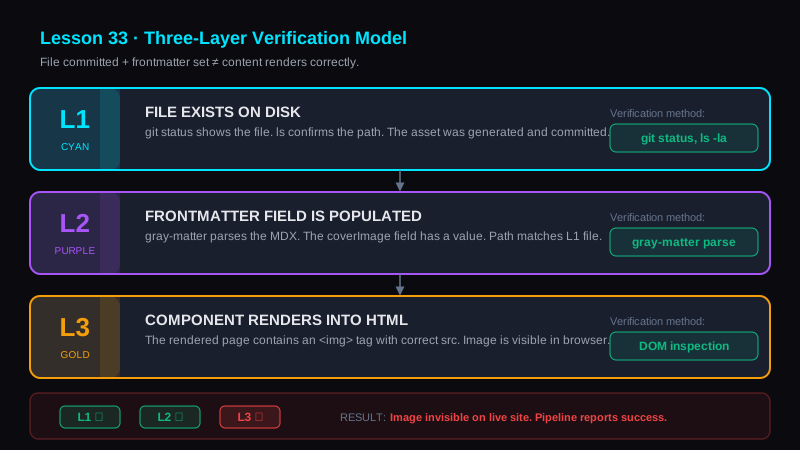
Every field in your MDX frontmatter is a contract with the rendering layer.
coverImage: "/images/blog-autopilot/slug.png" is not metadata. It is a promise that this file exists AND a React component will render it into an img tag in the DOM. If either half of that promise breaks, the contract is violated.
The Incident
February 2026. The blog-autopilot pipeline is running on schedule. Every other day: gather source material, generate article via Claude, generate hero image via Leonardo AI, commit to feature branch, open PR, merge, deploy.
The pipeline had been operating successfully for weeks. Images generated. Frontmatter populated. Articles published. Everything looked correct from the pipeline's perspective.
Then a manual audit revealed the truth: zero hero images were rendering on the live site. Not one. Every article had coverImage set in frontmatter. Every image file existed on disk. The React components — PostCard, ArticleHeader, FeaturedPosts — had the data wired through their props. But none of them contained an <img> tag that actually rendered the image.
The data flowed from frontmatter through the component tree. It arrived at the render function. And it stopped. The component received the coverImage prop but did not use it to produce visible HTML. The contract was half-fulfilled: the data side was complete, but the render side was missing.
Thirty articles. Every one published. Every one missing its hero image. The pipeline reported zero errors because, from its perspective, everything worked. The file was committed. The frontmatter was set. The PR was merged. What more could it check?
Layer 3. It could check layer 3.The Three Layers
Every piece of content in a pipeline passes through three distinct verification layers. Each one can pass or fail independently of the others. All three must pass for the content to be correctly rendered.
Layer 1: File exists on disk. The most visible layer. Run git status or ls and the file is there. Image generated, article written, asset committed. This is the layer developers naturally check because it is the output of the build step they just ran.
Layer 2: Frontmatter field is populated. Parse the MDX with gray-matter. The coverImage field has a value. The path matches an actual file. The frontmatter schema is satisfied. This layer is where your linting and schema validation tools operate.
Layer 3: Component renders the field into HTML. The React component that receives the coverImage prop actually produces an <img> tag in the rendered DOM. The image is visible when a human (or a headless browser) loads the page. This is the layer that matters to the reader — and it is the layer most pipelines never check.
Layer 1 and Layer 2 are about data. Layer 3 is about rendering. Data verification and render verification are independent operations. A field can be correctly populated in frontmatter and completely ignored by the component that receives it.
Most automated pipelines only verify Layers 1 and 2. Layer 3 requires loading the rendered page — which is why it gets skipped.
Where the Failures Hide
The gap between Layer 2 and Layer 3 is the most dangerous space in a content pipeline. Here is why.
Layer 1 failures are loud. The file does not exist. The git commit fails. The image generator returns an error. These are easy to catch because something visibly broke.
Layer 2 failures are detectable. A linter or schema validator can parse the frontmatter and flag missing or malformed fields. These require tooling but the tooling is straightforward — gray-matter parse, Zod schema, TypeScript interface.
Layer 3 failures are silent. The component receives the prop. The prop has a value. The component does not render it. No error is thrown. No exception is logged. The page loads. The image slot is empty. The only way to detect this failure is to inspect the rendered DOM — either manually or with a headless browser test.
This silence is what made the blog-autopilot incident possible. The pipeline checked Layer 1 (file committed) and Layer 2 (frontmatter populated). It never checked Layer 3 (image visible on page). And because Layer 3 failures produce no errors, the pipeline ran for weeks without a single warning.
Frontmatter as a Typed Contract
The solution starts with treating frontmatter as a typed, enforced contract — not a loose collection of optional metadata.
Define your frontmatter schema in TypeScript. Make required fields non-optional. Make optional fields explicitly documented with clear semantics for when they should and should not be present.
interface ArticleFrontmatter {
  title: string            // required: always
  date: string             // required: ISO format
  category: string         // required: one of defined categories
  excerpt: string          // required: one compelling sentence
  readTime: number         // required: minutes
  tags: string[]           // required: at least ["academy"]
  coverImage: string       // required: path to existing image
  featured: boolean        // required: controls FeaturedPosts inclusion
  status: "published" | "draft"
}

interface AcademyFrontmatter extends ArticleFrontmatter {
  lesson: number           // required: sequential lesson number
  track: string            // required: automation, discipline, foundations
  quiz?: QuizQuestion[]    // optional: when present, KnowledgeCheck renders
                           //           when absent, MarkComplete renders
}
The quiz field is an instructive example. It is optional — not every lesson needs a quiz. But the contract is explicit: when quiz is present, the KnowledgeCheck component renders. When quiz is absent, the MarkComplete component renders. The rendering behavior is determined by the contract, not by implicit assumptions in the component code.
Schema enforcement catches Layer 2 failures at build time. A missing coverImage field fails the schema check before the file is ever deployed. But schema enforcement alone does not catch Layer 3 failures — because the schema validates the data, not the render.
In God we trust. All others must bring data. And the data must be verified at the point of delivery, not the point of origin.
— W. Edwards Deming · Out of the Crisis, 1986
Pipeline Gates: The Layer 3 Check
The Layer 3 check requires a fundamentally different verification method than Layers 1 and 2. You cannot check it with file operations or schema parsers. You have to render the page and inspect the output.
The smoke test pattern: after deployment, load the rendered page in a headless browser. Query the DOM for the expected elements. Does the page contain an <img> tag with a src matching the coverImage path? Does the article body contain the expected heading structure? Does the quiz component render when quiz frontmatter is present?
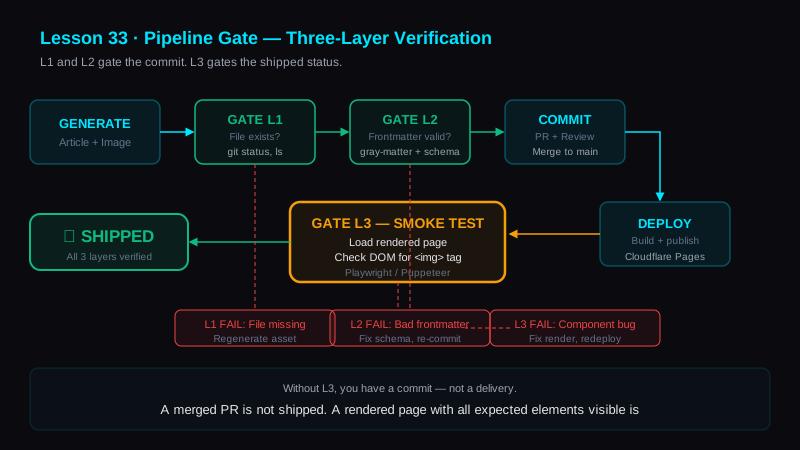
This test does not need to be complex. A Playwright or Puppeteer script that loads the URL, queries for img[src*="coverImage-path"], and asserts it exists. That is the entire Layer 3 check for hero images. Ten lines of code that would have caught the blog-autopilot incident on the first article, not the thirtieth.
The smoke test is not a replacement for unit tests or schema validation. It is a separate verification layer that catches a class of failures the other layers cannot see. Schema validation confirms the data is correct. The smoke test confirms the data is rendered.
The Contract Cascade
Frontmatter contracts cascade through the entire component tree. A single frontmatter field like coverImage touches multiple components:
PostCard — renders the thumbnail in the blog listing. Needs coverImage to show the card image.
ArticleHeader — renders the hero image at the top of the article. Needs coverImage for the full-width display.
FeaturedPosts — renders featured articles on the home page. Needs coverImage for the featured card.
OpenGraph meta tags — the og:image meta tag uses coverImage for social sharing previews.
One field. Four render targets. If the field is set but none of the components render it, you have a contract with four violations from a single root cause. And if you only check one component, you may fix it there while the other three remain broken.
The cascade means Layer 3 verification needs to check every render target, not just one. The hero image might render correctly in ArticleHeader but be missing from PostCard because the prop was passed under a different name. Each component's contract with the frontmatter field is independent and must be verified independently.
Making It Operational
The three-layer model becomes operational when it is encoded into your pipeline as gates — not suggestions.
Gate L1 (pre-commit): Before committing, verify the referenced files exist. If coverImage points to /images/blog-autopilot/slug.png, confirm that file is staged or already committed. This is a pre-commit hook or a CI check.
Gate L2 (CI): In your CI pipeline, parse all MDX files with gray-matter and validate against the TypeScript schema. Required fields must be present. Paths must be syntactically valid. Category values must be in the allowed set. This runs on every PR.
Gate L3 (post-deploy): After deployment, run a smoke test against the live URL. Load the article page. Query the DOM. Confirm the expected elements exist. This runs after every deploy — automated, not manual.
The gates are cumulative. L1 catches missing files. L2 catches malformed frontmatter. L3 catches render failures. Together, they cover the entire contract from data to DOM.
The deliver stage of your pipeline should not report "shipped" until all three gates pass. A merged PR is not shipped. A deployed site is not shipped. A rendered page with all expected elements visible in the DOM — that is shipped.
Lesson 33 Drill
Pick one content type in your system — blog posts, academy lessons, product pages. Trace the frontmatter schema from the MDX file to every React component that consumes it.
For each field, answer: does a component actually render this field into the DOM? Not "does it receive it as a prop" — does it produce visible HTML from it?
Find the gaps. Where a field is in the schema but not rendered, you have a Layer 2/Layer 3 mismatch. Where a field is rendered but not in the schema, you have an implicit contract that should be explicit.
Now write one smoke test. Load the rendered page. Check for one critical element — the hero image, the title tag, the quiz component. Run it after your next deploy. That is your Layer 3 gate. Everything before it was Layer 1 and Layer 2 pretending to be complete.
Bottom Line
Frontmatter is not metadata. It is a contract between your content, your schema, and your rendering layer. Every field promises that a piece of data will be present and that a component will display it.
When you verify only that the file exists and the field is populated, you are checking two-thirds of the contract. The final third — the rendered DOM — is where readers actually experience your content. It is also where most content pipeline failures hide, because no error is thrown when a component silently drops a prop.
Three layers. All three must pass. The file. The field. The render. That is the contract. Verify it end to end, or accept that "shipped" means "probably works."
Explore the Invictus Labs Ecosystem