The Async Agent Paradigm: From Prompting to Orchestration
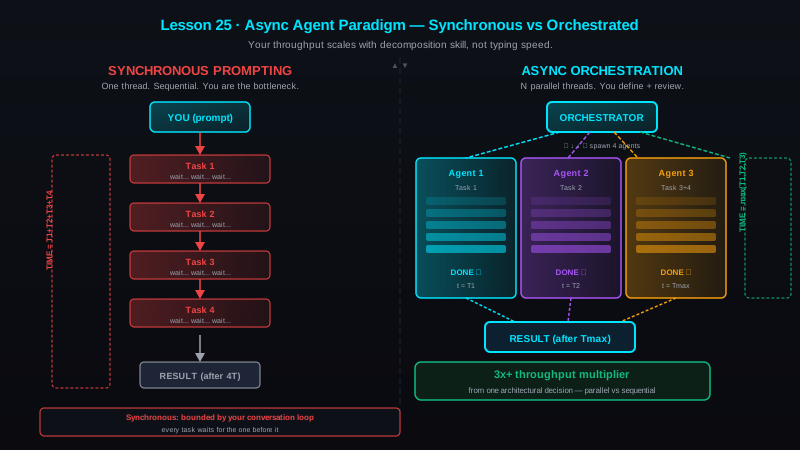
Prompting is synchronous. You type, you wait, you read, you type again. Your throughput is bounded by the conversation loop. Orchestration is different: you define work, spawn agents, do something else, collect results. The shift between these two mental models is the moment your AI OS starts outrunning what you can think.
The single biggest productivity unlock in AI-assisted development is not a better model. It is a different mental model.
Most builders use AI the way they used to use a search engine: ask a question, read the answer, ask the next question. One turn at a time. Synchronous, linear, bounded by the speed of the conversation loop. Your throughput in this model is limited not by the AI's capability, but by your own typing speed and reading rate.
That is the wrong model for building systems. The right model is orchestration.
The shift from prompting to orchestration is the moment your AI OS starts running faster than you can think. You are no longer the bottleneck in the production cycle.
The Synchronous Ceiling
In a synchronous prompting workflow, the conversation loop is the atomic unit. You write a prompt. The model responds. You read the response. You write the next prompt. Every step waits for the previous step to complete before it begins.
This works fine for questions. It does not work for systems.
When you need to write twelve lessons, generate twelve SVG diagrams, run twelve linting checks, and commit twelve files — the synchronous model means those twelve workstreams execute in series. The second lesson waits for the first. The third waits for the second. Total time: the sum of all twelve tasks.
The async model does not accept this constraint. It recognizes that these tasks are independent workstreams — they share no dependencies, do not conflict, and can proceed simultaneously. Total time: the duration of the longest single task, not the sum of all twelve.
The Concrete Mechanics
Claude Code's Task tool runs background agents. The parameter run_in_background: true spawns an independent execution thread that proceeds without blocking the main session. Each agent has its own context, its own scope, and its own completion signal.
The orchestration pattern:
- Define the outcome — precisely enough that the agent can self-verify completion
- Decompose into independent workstreams — identify which tasks share dependencies and which do not
- Spawn background agents — one per independent workstream, each with complete context
- Do other work — while agents run, the main session handles different tasks
- Collect results — review output, catch quality issues, synthesize across agents
For this Academy, three parallel agents wrote lessons 23, 24, and 25 simultaneously. Each had a complete spec: title, content outline, exact file paths, brand guidelines, component usage instructions. Each ran independently. Each completed in parallel. The time cost was the duration of the longest lesson — not the sum of all three.
For independent tasks, always background. A foreground agent that could have run in background is a tax on your session's throughput. The question before every task decomposition: do these workstreams share state? If no, they can run in parallel.
What Changes When You Think in Parallel
The shift from synchronous prompting to async orchestration requires a different approach to task design:
Synchronous thinking: "What should I do next?" — one task at a time, selected by current context.
Orchestration thinking: "What can run simultaneously?" — tasks decomposed into independent branches before execution begins.
The decomposition step is the new skill. It requires identifying:
- Which tasks have hard dependencies (B cannot start until A completes)
- Which tasks are genuinely independent (B and C can both start now)
- What context each independent agent needs to operate without asking questions
The last point is critical. An async agent that returns to ask a clarifying question has broken the async contract. It is no longer background — it is blocking, waiting for human input. The spec must be complete enough that the agent can proceed to completion and handle edge cases autonomously.
OpenClaw as Async Orchestration in Practice
The entire OpenClaw architecture is async orchestration expressed at the infrastructure level.
Cron jobs are agents executing scheduled tasks. They do not wait for Knox to be present. They do not ask questions. They execute their spec — gather data, synthesize with AI, deliver to Discord — and emit a completion signal. Knox reviews the output asynchronously, when it is convenient, not in real time.
The blog-autopilot skill runs on schedule: gather YouTube transcripts, generate article with Claude, generate hero image with Leonardo, open PR on GitHub. Knox wakes up to a draft article waiting for review. He was not present for the work. He did not direct each step. He reviewed the output.
This is the orchestrator role fully realized: define the system once, let it execute on schedule, review outputs on your own time. The work happens in parallel with everything else in your life.
The Compounding Effect
Synchronous prompting scales linearly. One conversation, one thread, one task at a time. Your monthly output is bounded by how many hours you can spend in active conversation with an AI.
Async orchestration scales with decomposition skill. The limiting variable is not your time — it is how well you can specify work that an agent can execute autonomously. As your decomposition skill improves, more tasks qualify for background execution. More tasks run in parallel. More work completes while you are doing other things.
The compounding dynamic: each well-specified background task is a template for the next. The blog-autopilot cron job was specified once. It has run hundreds of times since with zero additional prompting. The initial specification cost is amortized across every execution.
Async agents do not require your presence to produce value. They require your clarity at the specification stage. Invest in the spec. Invest in the context document. Invest in the acceptance criteria. That investment pays forward on every execution that follows.
Never tell people how to do things. Tell them what to do and they will surprise you with their ingenuity. The commander who micromanages his subordinates is not commanding — he is doing their jobs badly.
— General George S. Patton · War As I Knew It, 1947
The orchestrator's mandate: define the objective clearly, provide the context needed to execute autonomously, then get out of the way. Review the result. Adjust the spec if needed. Redeploy. This is the loop that produces compounding output.
Practical Transition Points
The shift from synchronous to async is not all-or-nothing. Start here:
Step 1: Identify your next three tasks. Which share dependencies? Which are independent?
Step 2: For independent tasks, write specs complete enough that an agent could execute without follow-up questions. This is the hard part — most specs are incomplete because we assume context the agent does not have.
Step 3: Run them in parallel. Measure the time difference against sequential execution.
Step 4: Review results. Note where agents needed clarification that could have been in the spec. Update the spec template.
The transition pays for itself on the second iteration. By the fifth, the quality of your specs has improved enough that background agents complete without quality issues at the rate that makes the parallel model genuinely faster, not just theoretically faster.
Drill
Take your next three tasks. Write them out as full specs — title, outcome definition, acceptance criteria, complete context, relevant file paths. Now ask: can any two of these run simultaneously without conflicting? If yes, spawn them as background agents and time the result. Compare that elapsed time to what sequential execution would have taken. That delta is your baseline parallel throughput gain. It only gets better as your decomposition skill improves.
Bottom Line: Prompting is a conversation. Orchestration is a system. The difference is not the model — it is the mental model. When you stop asking AI to help you and start defining work that AI executes autonomously in parallel, your throughput multiplier jumps from 1x to 3x minimum, with no ceiling except how well you can specify independent workstreams. Define clearly. Decompose ruthlessly. Delegate completely. Review strategically. That is the async agent paradigm.
Explore the Invictus Labs Ecosystem