Model Specialization: Choosing the Right AI for the Right Job
You are not choosing between AI providers. You are assembling a depth chart. Each model has a signature strength — and routing to that strength is the skill that separates serious builders from tourists.
Most builders pick one AI provider and stay loyal to it. They call this a stack decision. It is actually a capability handicap in disguise.
The builders who win are not the ones who found the best model. They are the ones who built a routing layer — a mental model (and often a literal one) that sends each task to the provider most suited to handle it.
Loyalty to one AI provider is a capability handicap. The winners are polyglot.
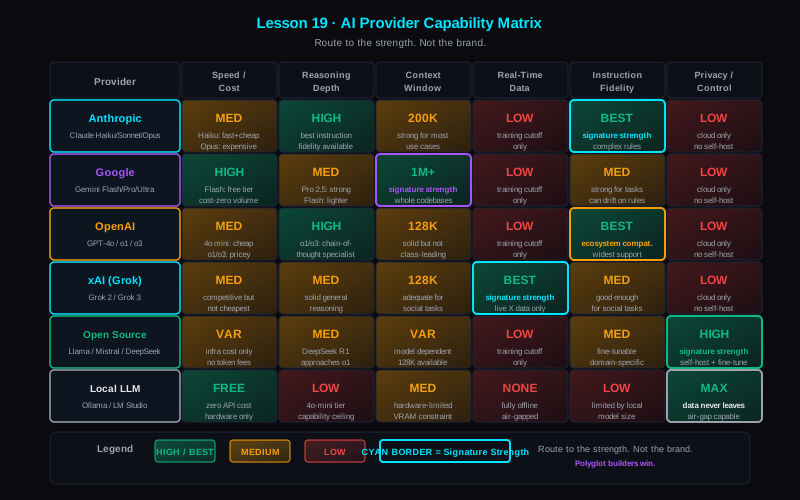
You are not choosing between vendors. You are assembling a depth chart. Every position has a specialist. Let me show you the depth chart.
Anthropic (Claude) — Reasoning, Coding, Complex Instruction
Claude's signature is instruction-following fidelity. When you need an agent to execute a multi-step process without drifting from the spec — clause by clause, constraint by constraint — Claude is the standard every other provider is measured against.
Haiku 4.5 is fast, cheap, and purpose-built for lightweight cognitive tasks. Classification, extraction, simple content formatting, Discord message generation. At approximately $0.25 per million tokens, it is the right model for high-volume gather-stage work that needs light AI — not zero AI.
Sonnet 4.6 is the workhorse. Balanced intelligence and cost. This is the primary model for blog-autopilot synthesis, complex analysis, and codebase work in Claude Code. When you need full reasoning capacity without Opus pricing — Sonnet is the answer. Budget roughly $3/M tokens in, $15/M tokens out.
Opus 4.6 is reserved for architecture decisions, strategy documents, and research synthesis requiring the deepest available judgment. Maximum reasoning. Use it sparingly — not because it underperforms, but because Sonnet handles 80% of cases at a fraction of the cost.
The rule: start with Haiku, step up to Sonnet when complexity demands it, reach for Opus only when the stakes and the reasoning requirements both justify it.
Google (Gemini) — Multimodal, Massive Context, Cost-Effective Synthesis
Gemini's signature is context length and multimodal capability. No other provider handles million-token contexts as cost-effectively. When the input is massive, mixed-media, or both — Gemini is the routing destination.
Gemini Flash 2.0 has a free tier and extreme speed. It is the model behind Invictus Sentinel's post-mortem generation — automated failure analysis that runs after every incident, with zero marginal cost. Flash handles image understanding, high-volume classification, and any synthesis task where "fast and free" beats "slow and premium." It is the workhorse for cost-zero AI operations.
Gemini Pro 2.5 unlocks deep reasoning at scale. A 1M+ token context window means you can feed it an entire codebase and ask architectural questions. You can drop in a 400-page research corpus and get synthesis. Use it when the input volume would crush any other model's context window.
The rule: Flash for volume and post-mortem automation, Pro when the input is genuinely massive or requires multi-document synthesis at scale.
OpenAI (GPT) — Ecosystem Compatibility, Structured Output, Broad Baseline
GPT's signature is ecosystem compatibility. If a third-party tool, library, or integration has one AI backend, it is probably OpenAI. This is not a capability argument — it is a network effects argument.
GPT-4o mini excels at structured output (JSON mode), classification, and API-compatible tasks. Use it when a downstream system requires OpenAI API format and the task is well-scoped.
GPT-4o is the strong generalist. Excellent function calling, broad capability, the widest ecosystem support. Use it as the "just works" model when you do not have a routing preference and need reliable broad capability.
o1 / o3 are chain-of-thought reasoning specialists. Hard math, logic verification, multi-step deduction, code correctness proofs. These models show their work — literally. Use them when you need the reasoning trace, not just the answer.
The rule: GPT-4o when compatibility matters, o1/o3 when the problem is hard reasoning and you need to audit the chain.
xAI (Grok) — Real-Time Social Data, Temporal Freshness
Grok's signature is temporal freshness. It has access to real-time X data that no other model can see. Not last month's X. Not a snapshot. Right now.
Grok 2/3 powers social signal analysis, crypto narrative sentiment, trending topic extraction from X. When you need to know what is happening on the platform in the last 24 hours — Grok is the only routing destination. Every other model is working from a training cutoff.
This is why grok-search-mcp is in the active stack. Not for general search. For live X intelligence, which no other provider delivers.
The rule: any task requiring current X/Twitter data routes to Grok, period.
Open Source (Llama, Mistral, Qwen, DeepSeek) — Fine-Tuning, Privacy, Scale
Open source models have one signature no commercial provider can match: control.
Llama 4 (Meta) has strong general capability and a permissive license. It is the baseline for self-hosted deployments and domain-specific fine-tuning. When you need to train a model on proprietary data, Llama is the starting point.
Mistral (Mixtral 8x7B, Mistral Large) is a European provider with strong multilingual capability. When GDPR compliance matters or you need European data residency, Mistral is the routing destination.
Qwen 2.5 from Alibaba Cloud leads on specific code generation benchmarks and multilingual tasks. Strong option for polyglot content pipelines.
DeepSeek R1 delivers o1-class reasoning at open source cost. Open weights, strong reasoning trace, available for self-hosted deployment. If you want chain-of-thought reasoning without o1 pricing, DeepSeek R1 is the answer.
The rule: when data cannot leave your infrastructure, when you need fine-tuning, or when you are building a product with AI embedded — open source is often the correct architectural decision.
He who knows when he can fight and when he cannot will be victorious.
— Sun Tzu · The Art of War
Knowing which model can win your task — and routing accordingly — is the same discipline applied to AI selection.
Local LLMs (Ollama, LM Studio) — Privacy, Zero Latency, Air-Gap
Local models have one use case that no cloud provider can touch: data that cannot leave the building.
Client data, medical records, legal documents, proprietary business logic — if it cannot hit an external API, you run it locally. Ollama (CLI-based) and LM Studio (GUI) are the standard deployment options on Mac/Linux.
The tradeoff is real and non-negotiable. The best local model today — Llama 3.1 70B — performs roughly at GPT-4o mini tier. You are trading capability ceiling for complete control.
If your data cannot leave the building, local LLMs are not a compromise. They are the only option.The rule: local for privacy and zero API cost, cloud for capability when the data allows it.
The Routing Matrix
This is the mental model. Every task routes somewhere — here is how to decide.
Code, reasoning, complex instructions → Claude Sonnet or Opus. Instruction-following fidelity wins.
Cheap, high-volume synthesis → Gemini Flash. Free tier, fast, good enough for gather-stage AI.
Massive context — whole codebase, long documents → Gemini Pro. No other provider matches the context window at this cost.
Real-time X/social signal → Grok. No alternative exists.
Ecosystem compatibility, function calling, "just works" → GPT-4o. Widest integration surface.
Hard math, logic verification, reasoning trace → o1 or o3. Show your work.
Privacy, fine-tuning, self-hosted → Open source (Llama, Mistral, DeepSeek).
Air-gapped, zero API cost, sensitive data → Local LLM via Ollama or LM Studio.
The routing matrix is not a preference list. It is a decision tree. The task characteristics determine the destination — not brand loyalty, not familiarity, not inertia.
Most builders who "use Claude for everything" are leaving Gemini Flash's free tier on the table for high-volume tasks. Most builders who "use OpenAI by default" have never run a million-token context through Gemini Pro. Most builders who "avoid open source" have never needed to process data that cannot leave their infrastructure — until they do.
Build the routing layer before you need it. The time to establish model discipline is not when you hit a constraint — it is before the constraint arrives.
Drill
Identify your three most frequent AI-powered tasks. For each one, write down:
- Which provider you currently use for it
- Which provider the routing matrix says should handle it
- Whether they match — and if not, what the cost or capability gap is
If they do not match, pick one task this week and migrate it to the correct provider. Measure the difference in quality and cost. That delta is the value of the routing layer.
Bottom Line: The AI landscape is not a competition with one winner. It is a depth chart with specialists. Claude for reasoning and instruction-following. Gemini for context and multimodal volume. GPT for ecosystem compatibility. Grok for live social data. Open source for control. Local for privacy. The builders who understand this build systems that punch above their cost. The builders who pick one and stay loyal are leaving capability on the table — every session, every day.
Explore the Invictus Labs Ecosystem