Watchdogs and Self-Healing: Building AI Systems That Don't Die Silently
Your AI pipeline failed three days ago. You're still publishing its outputs. Silent failure is the failure mode nobody talks about — until it's too late.
The most dangerous failure mode in an AI system isn't a crash. A crash is loud. A crash produces logs, errors, and empty outputs that someone eventually notices.
The dangerous failure is the system that keeps running — posting stale content, sending outdated signals, executing on bad data — while you assume everything is fine.
The Nightmare Scenario
Your blog autopilot breaks silently on a Tuesday. The gather stage fails with a network timeout, but the deliver stage has no way to know that, so it runs anyway with the last successful context file. Your site publishes a duplicate article. Your audience notices before you do. Three days pass.
This isn't hypothetical. This is exactly what happens when you build fast and skip the monitoring layer.
Silent failure is categorically worse than loud failure. Loud failures are recoverable — you see them, you fix them, you move on. Silent failures compound. Every hour the broken system runs, the damage grows and the blast radius expands.
The system that monitors itself is blind to its own death. If your alerting infrastructure goes down, you need a separate system to tell you that — not the same system using itself to report on itself.
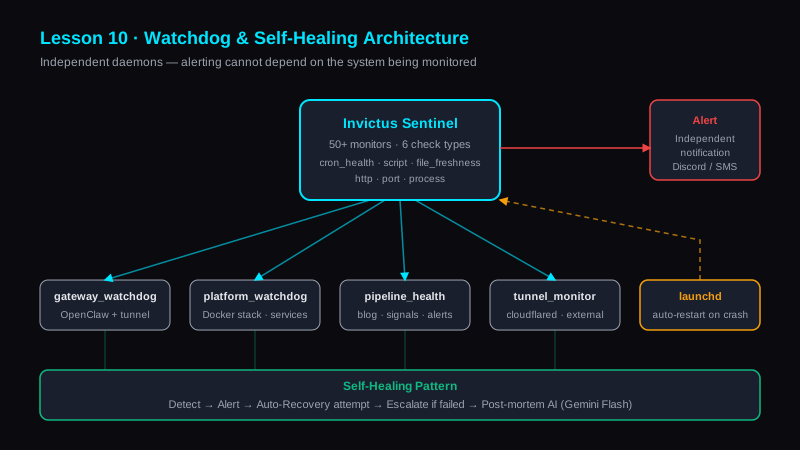
Invictus Sentinel: 50+ Monitors Across Six Check Types
Invictus Sentinel is the monitoring daemon that watches the entire production stack. Not one or two critical services — everything that matters.
Six check types cover the full failure surface:
cron_health — Did the scheduled job actually run in the expected window? A cron that silently stops firing doesn't throw an exception. It just... doesn't run. Sentinel tracks last-seen timestamps for every scheduled job.
script — Did the script complete with exit code 0? Sentinel runs health-check scripts and validates their output, not just their exit code.
file_freshness — Is this output file younger than its expected update interval? If the weekly briefing JSON is 10 days old and the job runs daily, something is broken.
http — Is this endpoint returning 200? Not just reachable — returning the expected response.
port — Is this service listening on the expected port? Covers all Docker services, MCPs, and local daemons.
process — Is this daemon running? Covers OpenClaw, the Excalidraw canvas server, the CapCut MCP, and everything else that should be a persistent process.
The Fundamental Rule of Monitoring
Alerting cannot depend on the system being monitored.This is the axiom that most monitoring setups violate. They build one unified alerting pipeline — one Discord bot, one notification service — and route all alerts through it. Then the Discord bot goes down. You get zero alerts. You find out when you check Discord and nothing has posted in four hours.
This is why we run independent watchdog daemons with independent notification paths:
gateway_watchdog — watches the OpenClaw gateway process and the tunnel that exposes it externally. If the gateway dies, this daemon detects it and attempts a restart before alerting.
platform_watchdog — monitors the full Docker stack. Individual service health, network connectivity, and cross-service dependencies.
pipeline_health — tracks the content pipelines: blog-autopilot, signal-drop, trade-alerts. Watches output file freshness and last-run timestamps.
tunnel_monitor — independent check on the cloudflared tunnel. The tunnel going down silently broke external access twice before this watchdog existed.
Each watchdog is a separate launchd daemon. Each has its own notification path. If one watchdog fails, the others still function.
Don't build your monitoring stack on the same infrastructure you're monitoring. A watchdog that runs inside your Docker stack cannot reliably tell you when your Docker stack is down. It dies with the thing it's watching.
launchd Over Cron on macOS
Cron is stateless. If a cron job crashes, cron doesn't know, doesn't care, and doesn't restart it. You get silence.
launchd is the macOS service manager that does what cron doesn't: it restarts processes that crash, enforces resource limits, logs to the system journal, and maintains run intervals with drift correction. Every persistent daemon in this stack runs under launchd, not cron.
The practical difference: if a watchdog daemon crashes at 3 AM, launchd restarts it within seconds. If a cron job crashes at 3 AM, you find out when you check manually.
Post-Mortem AI: Closing the Loop
When an incident fires, the response has four stages: detect → alert → attempt auto-recovery → escalate if needed.
Auto-recovery attempts are specific and bounded. If the gateway process is down, restart it and wait 30 seconds. If it comes back up, close the alert. If it doesn't, escalate with a full context dump. Never run unbounded recovery loops — a recovery script that can't succeed and keeps retrying is a second failure layered on top of the first.
After every incident that requires escalation, Gemini Flash auto-generates the post-mortem report. The system collects the timeline of events, the alert log, and the recovery actions, and produces a structured incident report: what happened, when it started, what failed, what fixed it, and the recommended rule change to prevent recurrence. That report goes into the incident log and into the relevant lessons.md.
An incident that doesn't produce a lesson is an incident waiting to repeat. The post-mortem isn't paperwork — it's the mechanism that converts failures into system improvements. Skip it and you're running the same risk again tomorrow.
The Self-Healing Pattern
The monitoring architecture isn't just about notification — it's about recovery. Where possible, the watchdog attempts to fix the problem before waking up a human.
Gateway down → restart the process. Stale file detected → trigger the pipeline. Port not listening → restart the service. Each recovery attempt is logged. Each failed recovery attempt escalates.
The goal is an AI system that handles its own common failure modes without human intervention, escalating only when the failure is novel or the recovery attempt fails.
Lesson 10 Drill
Identify the three most critical components of your current AI setup — the three things whose failure would cause the most damage.
For each one, answer: what does failure look like, how would you know it failed, and does anything currently detect that failure independently?
If any of those three questions produces "I wouldn't know for a while" or "I check manually," that's your highest-priority monitoring gap. Fix it this week.
Bottom Line
Every AI system will fail. The ones that fail loudly and recover fast are fine. The ones that fail silently and keep running are the ones that do real damage.
Build your monitoring layer before you need it. The watchdogs don't just protect your system — they protect your users, your brand, and the trust you've built with an audience that expects consistent signal.
Silent failure is not an option.
Explore the Invictus Labs Ecosystem