The Content Flywheel: Automated Research to Multi-Platform Publishing
Content creation is a bottleneck that kills builder brands. The fix is not writing faster — it is pipeline-izing every stage so AI handles synthesis and you handle strategy.
Every serious builder I know has the same problem.
The work is good. The thinking is deep. The insights are there. But the content never makes it out because they are too busy doing the work to document it.
The bottleneck is not creativity. It is production.
You do not have a content problem. You have a pipeline problem.
Every stage of content creation that follows a repeatable pattern should be automated. The human stays in the strategy loop, not the production loop.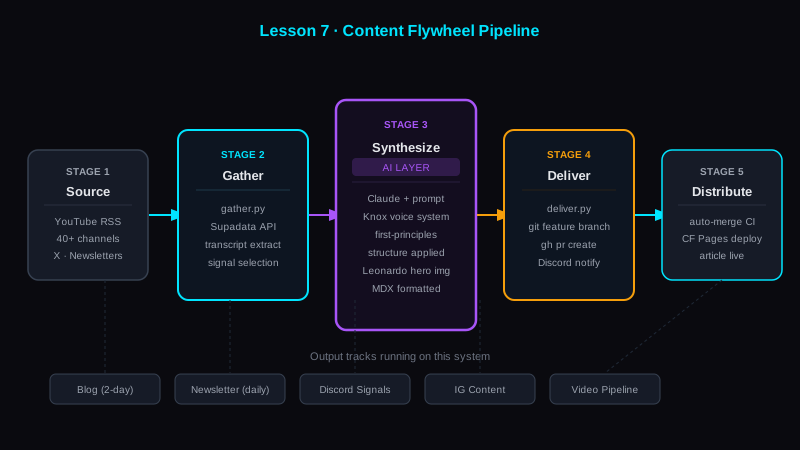
The Five-Stage Framework
Any content pipeline can be decomposed into five stages. The question for each stage is: does this require a human, or does it follow a repeatable pattern that AI can execute?
Stage 1 — Source / Gather: Where does the raw signal come from? YouTube channels, RSS feeds, X accounts, newsletters, research papers, Discord conversations. The gather stage collects this material on a schedule.
Stage 2 — Synthesize: AI processes the raw signal. This is the intelligence layer — not copying, not summarizing, but synthesizing into something new. Pattern recognition across sources, distillation of core insight, translation into a specific voice and audience.
Stage 3 — Format: The synthesized content gets structured for its destination. Blog post needs frontmatter, headers, callouts, and a cover image. Newsletter needs subject line, preview text, section breaks. Discord post needs embedded links and concise framing.
Stage 4 — Deliver: The formatted content goes to its staging location. Git PR for a blog post. Beehiiv draft for a newsletter. Discord webhook for community posts.
Stage 5 — Distribute: Final publication. Auto-merge on CI pass. Schedule send. Cross-post to platforms.
The question for each stage is not "can AI do this?" — AI can do most of it. The question is "where does authentic human judgment actually change the output quality?" That is where you stay in the loop. Everywhere else, automate.
Blog Autopilot: The Reference Implementation
Here is how this plays out in production.
Blog Autopilot is a four-script pipeline that runs every other day at 9 AM ET. It publishes original articles to jeremyknox.ai without requiring me to write a word.
gather.py — Pulls the RSS feed from a curated list of 40+ YouTube channels. Identifies new videos published since the last run. Extracts full transcripts using the Supadata API. Selects the highest-signal video for the day's article.
synthesize.py (Claude) — Feeds the transcript to Claude with a structured prompt that encodes the Knox voice: analytical, direct, contrarian framing, first-principles thinking. The output is not a transcript summary. It is a fully original article that uses the source material as research, the same way a journalist would.
generate_image.py — Calls Leonardo AI's Phoenix 1.0 model with a cinematic preset and a title-derived prompt. Generates a 1024x576 hero image specific to the article's subject matter. Saves it to the correct directory with the correct naming convention.
deliver.py — Creates a feature branch, writes the MDX file with properly structured frontmatter, commits the hero image, and opens a GitHub PR via gh pr create. Notifies Discord's logs channel that a new article is ready.
Auto-merge fires on CI pass. Cloudflare Pages deploys on merge to main. Article is live.
The key insight here: Claude is the synthesis layer, not the creative director. The voice is encoded in the prompt. The structure is encoded in the MDX schema. The quality standards are encoded in the CLAUDE.md. Claude executes consistently within those constraints — and the output sounds like Knox because the constraints define what Knox sounds like.
You do not need to write every article. You need to define the system once, then maintain the system.
The Extended Flywheel
Blog Autopilot is one output track. The same gather-synthesize-format-deliver-distribute pattern scales across every content format:
Weekly Signal Drop — Blog Generator runs daily at 7 AM. InDecision crypto analysis, market synthesis, intelligence briefing. Outputs to Beehiiv for the Signal Drop newsletter. Same five stages, different source signal and output format.
Discord Intelligence Posts — trade-alerts skill monitors market conditions and posts structured signal updates to the Hive Mind Discord. Trigger-based rather than cron-based, but the same pipeline logic.
Instagram Content — content-factory pipeline takes this further: script generation, visual creation via CapCut, ElevenLabs voiceover, karaoke-style captions, platform-formatted export. The production work that used to take hours now runs programmatically.
Content Stockpile — a rolling backlog of article concepts, Instagram hooks, newsletter angles — continuously generated and queued so the pipeline always has material to work from.
Notice what is missing from this list: me, in a content creation session, staring at a blank page.
The flywheel spins without my presence. When I do engage with content, it is at the strategic layer — refining the voice system, identifying new source channels, setting publishing cadences. The production loop runs independently.
That is the leverage model.
What AI Cannot Do (Yet)
Honest accounting matters here.
AI cannot develop original frameworks. The InDecision Framework — the 6-factor crypto analysis model — came from years of pattern recognition and a specific mental model I built. AI can execute that framework with fidelity, but it could not have invented it.
AI cannot know your audience better than you do. The voice system works because I spent time encoding what Knox actually sounds like — the analogies I reach for, the frameworks I trust, the things I push back on. That encoding took deliberate work.
AI cannot catch domain errors without domain knowledge. An article about a crypto mechanism can sound confident and be factually wrong. The human review step matters for high-stakes claims.
The practical rule: AI handles production, humans maintain the voice system and review for domain accuracy. That division of labor scales.
Lesson 7 Drill
Pick one content format you repeat manually on any cadence — weekly report, LinkedIn post series, newsletter, internal team update, anything.
Map it to the five stages:
- Source — where does the raw input come from?
- Synthesize — what does processing/writing this actually involve?
- Format — what structure does the output need?
- Deliver — where does it go when it is ready?
- Distribute — how does it reach the audience?
For each stage, mark it: Human Required or Automatable.
If more than two stages are automatable, you have a pipeline waiting to be built.
Bottom Line
The builder who publishes consistently, at quality, on schedule, without burning creative capacity on production work — that builder compounds.
The audience grows while they are building something else.
The reputation accumulates while they are focused on the next problem.
The content flywheel does not replace creative thinking. It liberates it. You think deeper because you are not bogged down in production. And the production runs anyway.
Build the flywheel once. Let it spin.
Explore the Invictus Labs Ecosystem