The Oracle Flywheel: Turn Complexity Into Clarity People Remember
Data does not move people. Narrative does. The analyst who translates complexity into a sentence people remember is worth ten who cannot.
The analyst who produces the most data does not win.
The analyst who produces the clearest interpretation wins.
This is the mistake most technically skilled people make: they believe thoroughness is the product. They deliver 40-page reports, complex visualizations, nuanced multi-scenario analyses. And their audience stares at it, nods politely, and makes decisions based on gut instinct anyway — because no one translated the data into a decision.
Data does not move people. Narrative does. The person who can take a complex signal and translate it into one sentence their audience can remember, act on, and repeat to others — that person has leverage. The person who hands over raw analysis has done useful work that produces no change.
The Oracle standard: Complex in source. Simple in delivery. Actionable in outcome.
This is the brand DNA of The Code Whisperer. Not complexity for its own sake. Not simplification that loses signal. Clarity that drives decisions.
Why Translation Is the Skill
Every domain expert faces the same problem. The deeper your expertise, the harder it becomes to communicate with people who do not share it. You see the nuance. You know the caveats. You understand the second and third-order effects. So your output gets longer, more qualified, more conditional — and less useful.
The Oracle skill is the inverse discipline: you have done the complex analysis, and now your job is to distill it to its highest-leverage interpretation in the simplest possible language. Not "the market is showing mixed signals with uncertainty across macro factors." That is not translation. That is deferral.
Translation sounds like: "BTC shows 73% conviction for a breakout above 97k — here is the three-scenario tree and what triggers each."
The audience knows exactly what it means. They know what to watch for. They know what to do in each scenario. That is actionable in outcome.
The Four-Stage Flywheel
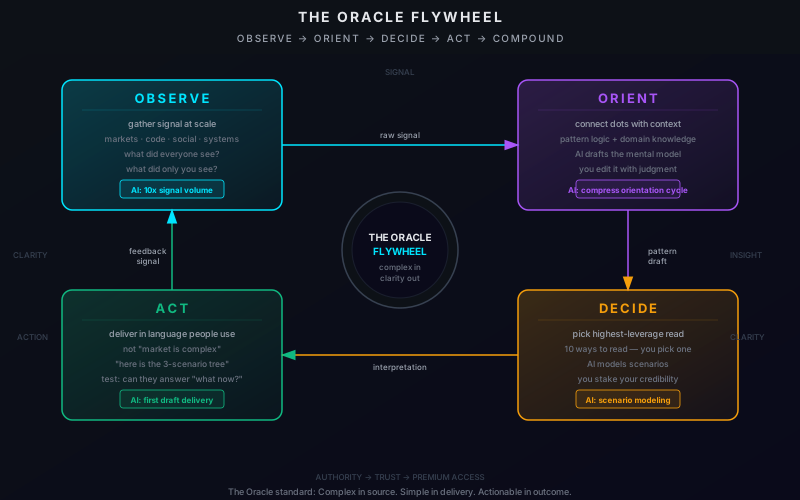
The Oracle Flywheel is a four-stage loop. Each stage builds on the last. AI accelerates every stage — but the judgment layer stays human.
Stage 1 — Observe
Gather signal from markets, systems, code, behavior. This is the data layer. Volume matters less than the quality of observation. The question is not "how much did you read?" — it is "what did everyone see, and what did only you see?"
The Oracle advantage begins at observation because most people read the same sources. The operator who has automated signal gathering across 40+ channels, monitoring real-time social signal on Grok, running sentiment analysis across Discord communities, and tracking multiple correlated datasets simultaneously — that operator observes a broader and earlier signal than the person who reads the same three newsletters everyone else reads.
Stage 2 — Orient
Connect the dots with context and pattern logic. This is where AI creates asymmetric leverage.
Claude Opus analyzing 50 articles plus market data plus your domain knowledge generates orientation in hours that would take days solo. But the model generates the first draft of the mental model — you edit it with judgment. The model does not know which patterns are structurally significant versus noise. You do. The combination is the edge.
The Oracle advantage is not that you are smarter than your competition. It is that you translate faster and clearer. AI compresses the observation and orientation cycle dramatically — but the judgment about which interpretation has the most predictive power stays yours.
Stage 3 — Decide
Choose the highest-leverage interpretation from the noise. There are always 10 ways to read a situation. The Oracle picks the one with the most predictive power and the clearest action path.
This is the hardest stage and the one that cannot be delegated to a model. AI can model scenarios. AI can weight probabilities. But the call — the specific interpretation you are willing to stake your credibility on — requires domain confidence and the willingness to be wrong publicly. That is a human judgment.
The discipline: when you have finished the analysis, make the call. Do not present five equally-weighted scenarios and let the audience decide. That is not Oracle output. That is hedge output. Pick your highest-conviction interpretation, present it with supporting evidence, and give the audience the context to challenge you.
Stage 4 — Act
Deliver guidance in language people can use today.
Not "the engineering landscape is evolving with AI tooling." That tells your audience nothing. "Stop hiring generalist junior developers for boilerplate work — AI handles that now. Hire for systems judgment and domain architecture." That is actionable. Your audience knows what to do with it this week.
The delivery test: read your conclusion and ask — "What should I do with this information?" If the answer is not immediately clear to your audience, the translation is incomplete. Go back and finish it.
The Translation Discipline in Practice
Here is how the Oracle translation works in the content flywheel:
Raw YouTube transcript from a senior engineer's conference talk → Knox synthesis via Claude with voice constraints encoded → formatted MDX article with Callout-enriched insights and specific recommendations for engineering managers → published to jeremyknox.ai.
The source material and the output look nothing alike. The source is 45 minutes of meandering conference talk with half-formed ideas and audience Q&A. The output is 1,200 words of direct, analytical, actionable guidance for a specific audience.
That transformation is the Oracle translation working. Not summarization. Not transcription. Translation — from raw signal to structured insight to delivered guidance.
You do not lead by hitting people over the head — that is assault, not leadership. You lead by taking them where they need to go.
— Dwight D. Eisenhower · Presidential Press Conference, 1957
The Oracle parallel: you do not lead your audience by overwhelming them with analysis. You lead them by taking them from confusion to clarity to decision. The data is the mechanism. The translation is the leadership act.
The Business Effect of the Flywheel
When your community consistently receives clarity from your Oracle output, something structural changes: they develop confidence in your judgment. Not your data access — your judgment. They know that when you say something, it has already been filtered through a disciplined translation process. The noise has been removed. What remains is actionable.
That confidence compounds into authority. Authority compounds into premium access revenue. Hive Mind Signals — $29 community, $50 elite tier — is built on this foundation. The community pays not for data (data is free) but for translated clarity they trust.
The flywheel's business effect: signal generates insight, insight generates clarity, clarity generates authority, authority generates trust, trust generates back to signal — because people bring you their best observations when they trust your translation.
What AI Does to Each Stage
The acceleration is real. The ownership structure is equally real.
Observe: AI reads 10x more signal than you can alone. Automated gathering across channels, real-time monitoring, pattern detection at scale.
Orient: AI generates hypotheses and pattern drafts in minutes. You validate with domain judgment and discard the ones that do not hold.
Decide: AI models scenarios and weights probabilities. You make the call. The credibility behind the call is yours.
Act: AI writes the first draft. You edit for voice, precision, and audience fit. The final word is yours.
The Oracle is not replaced by AI. The Oracle is amplified by it — because the human judgment at each stage is what turns AI output into trusted authority. Without the judgment layer, AI produces competent-sounding analysis that no one acts on. With it, AI produces the raw material and the Oracle turns it into direction.
Lesson 3 Drill
Take the last complex AI analysis you produced. Apply the Oracle test:
- Can your audience answer "what should I do with this information?" in 10 seconds?
- If not, identify where the translation broke down — Observe (incomplete signal), Orient (missed the key pattern), Decide (refused to make the call), or Act (delivered analysis instead of guidance).
- Rewrite only the conclusion. Make the call. State the recommended action in one sentence.
That one-sentence conclusion rewrite is the Oracle discipline in its simplest form.
Bottom Line
AI gives you velocity at every stage of the flywheel. It reads more, synthesizes faster, models scenarios at scale, and writes first drafts on demand.
But velocity without translation produces faster noise.
The Oracle standard — complex in source, simple in delivery, actionable in outcome — is what converts AI velocity into actual influence. Your audience does not need more information. They need less, better filtered, and clearly translated into what to do next.
Build the flywheel. Run the translation discipline every time. And watch the gap between your output and everyone else's compound.
Explore the Invictus Labs Ecosystem